






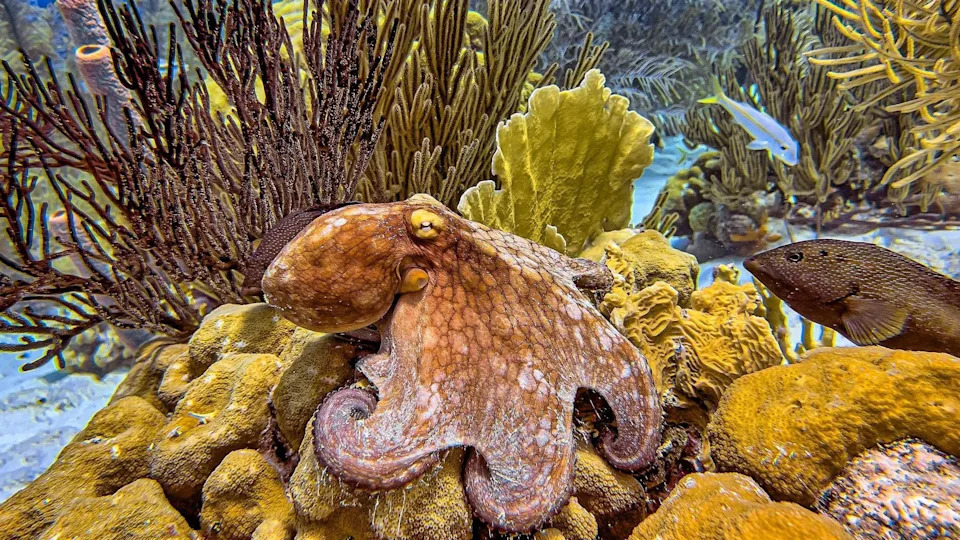
Big octopuses might have dominated the traditional oceans 100 million years in the past, when dinosaurs roamed, in accordance with new analysis.
Among the earliest octopuses are believed to have been highly effective predators outfitted with robust arms for grabbing prey and beak-like jaws for munching on the shells and bones of different animals.
A brand new research of some remarkably effectively preserved jaws counsel they reached as much as 19 metres, doubtlessly making them the biggest invertebrates ever identified to scientists.
For many years, palaeontologists believed that the biggest ocean predators have been vertebrates with backbones akin to fish and reptiles whereas invertebrates like octopuses and squid performed supporting roles.
A Big Pacific Octopus assembly a diver on the ocean ground [Getty Images]
New analysis by scientists from Hokkaido College in Japan challenges the image scientists had of historic octopuses.
Their evaluation of fossil jaws suggests big octopuses glided by way of the oceans outfitted with the power to chew on the laborious shells and skeletons of huge fish and marine reptiles.
The research estimates a physique size of about 1.5 to 4.5 metres, which, when the lengthy arms are included, involves a complete size of roughly 7 to 19 metres.
Even on the decrease finish of that vary, the animal would have been monumental by in the present day’s requirements.
One other placing function is that the damage on the fossilised jaws is uneven from left to proper, suggesting the animals might have favoured one facet when feeding.
In dwelling animals, favouring one facet of the physique over the opposite is linked to superior mind perform.


Octopuses are identified for his or her extraordinary intelligence and for being masters of camouflage [Getty Images]
Trendy octopuses are identified for his or her intelligence, downside fixing and complicated looking methods.
The Big Pacific Octopus, the biggest dwelling species in the present day, can have an arm span of greater than 5.5 metres.
Video footage exhibits these animals taking over sharks greater than a metre lengthy.
“With their tentacles and their suckers they may completely maintain on to such an animal and there’s no escape,” stated Christian Klug, a palaeontologist on the College of Zurich, who reviewed the analysis.
Nonetheless, many questions stay. Scientists can solely guess on the precise form of the animals, the dimensions of the fins, or how shortly they may swim.
And no fossil has but been discovered with abdomen contents that will supply direct proof of what they have been eating on.
Dr Nick Longrich, a paleontologist on the College of Tub, stated his hunch was that they have been primarily preying on ammonites.
Nonetheless, like the fashionable octopus, they might have been opportunistic and voracious predators, and would not have handed up different prey if that they had the prospect.
“It should take some time earlier than we determine this factor out,” he stated. “It’s kind of of a thriller.”
For now, the fossils supply a tantalising glimpse of an enormous of the deep which will have roamed historic seas, armed with a crushing jaw, highly effective arms, and a mind which will have helped it compete with different high predators.
The analysis is printed within the journal, Science.