






Lengthy earlier than smartphones and authorities apps, India used its huge postal community to influence folks to participate in one of many world’s greatest statistical workouts: the census.
Now, as India prepares for its sixteenth census – the eighth since independence in 1947 – a brand new exhibition revisits that forgotten historical past by stamps, postmarks and letters as soon as used to rally residents behind the nationwide headcount.
The exhibition, curated by Vikas Kumar, an economics professor at Bengaluru’s Azim Premji College, explores how India’s postal system grew to become an unlikely instrument of nation-building within the many years after independence.
Unbiased India urgently wanted dependable demographic statistics – each to run elections based mostly on common grownup franchise and to construct a deliberate financial system.
The census was thought-about so central to the brand new republic’s political financial system that the Constituent Meeting handed the Census Act in 1948, even earlier than the structure was finalised.
An envelope mailed from Nandikotkur in January 1951 and delivered in Madras (now Chennai) days later bears one of many earliest identified bilingual postmarks selling India’s first post-independence census. The black pictorial stamp – exhibiting a household of three with “Census of India, February 1951” in Hindi and English – grew to become a broadly used census postmark of the period. [Vikas Kumar]


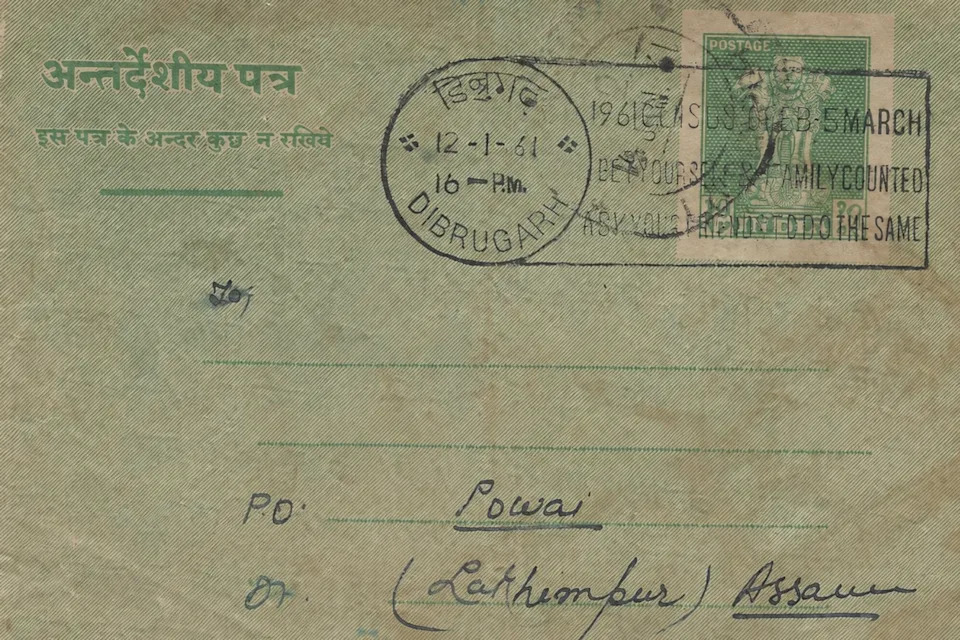
This inland letter card, mailed inside Assam in January 1961, carried a census postmark urging Indians to “Get your self & household counted” – and to influence buddies to do the identical. It was a part of a nationwide postal marketing campaign that turned on a regular basis mail right into a device of public mobilisation. [Vikas Kumar]
Mailed from Dausa to Jaipur in February 2001, this postcard carried a Hindi census postmark urging Indians to share particulars about themselves and their households “with none hesitation”. It mirrored how the census relied not simply on counting folks, however on persuading them to belief the state with their info. [Vikas Kumar]
However the authorities confronted two fast challenges: how you can persuade folks to take part within the census, and how you can preserve communication between enumerators and census officers throughout an unlimited, poor and largely rural nation.
Belief was a specific concern. The colonial censuses of 1931 and 1941 had confronted boycotts in elements of India, whereas the 1941 headcount in Punjab and Bengal was marred by allegations of communal manipulation. Public outreach, subsequently, grew to become crucial to the legitimacy of impartial India’s first census.
That’s the place the put up workplace got here in.
Till just a few many years in the past, the postal division was the biggest unified communications community out there to the Indian state.

Three million commemorative stamps have been issued in 1971 to mark the centenary of the census, celebrating the nation’s variety by faces embedded inside the quantity 100. The primary day cowl paired census imagery with slogan postmarks urging Indians to take part in one of many world’s largest counting workouts. [Vikas Kumar]

Issued for the 2011 Census, this commemorative stamp confirmed households holding arms alongside an enumerator and the census emblem. The primary day cowl paired a pixellated map of India with a cancellation mark carrying the census image – reflecting a rustic coming into the digital age of counting. [Vikas Kumar]
After independence, the postal system expanded sooner than most different public networks, together with banking. By 1968, greater than 100,000 put up workplaces have been delivering mail every day to 300,000 villages and weekly to a different 300,000 extra.
Kumar’s analysis reveals how in a different way the Indian state as soon as communicated with residents.
Within the run-up to the 1951 census – the primary after independence – the federal government used a bilingual pictorial postmark stamped on letters travelling throughout the nation.
The postmark confirmed a household of three framed by the phrases “Census of India” in Hindi and English.

A supervisor in Rajasthan’s Bhilwara district mailed this pre-printed postcard on 23 February 1970 to trace mapping, home numbering and enumeration work for the 1971 Census. [Vikas Kumar]
The marketing campaign was rigorously calibrated for a rustic with low literacy charges. Postmen usually doubled as readers, scribes and casual state intermediaries in villages, making the postal community a super car for public messaging.
Over the many years, the messaging advanced with the nation itself.
In 1961, postmarks urged Indians to “Get your self and all of the household counted” and “Ask your mates to do the identical”.
By 1971, commemorative stamps celebrated the census as “one of many largest administrative operations on the earth”, proudly noting that inhabitants knowledge was now being processed utilizing digital computer systems.
The postal materials additionally reveals how governments imagined the census itself.
Commercials in 2000 described it because the “Mirror of the nation” and a “Group {Photograph} of the nation”, presenting the census much less as a bureaucratic train than as a collective self-portrait.

“Improvement’s milestone – Census” learn this slogan printed on postcards issued in 13 languages forward of India’s 2001 census, reflecting how the train was framed as central to nation-building and progress. [Vikas Kumar]

“Group {Photograph} of the Nation”: Issued forward of the 2001 Census, these multilingual postcard commercials carried the census message throughout India. This Hindi-English model dates to January 2001. [Vikas Kumar]
2001/Mirror of the Nation ‘Census’: This census advert was featured on postcards in October 2000 earlier than the family section of the 2001 census. These postcards have been issued in 13 languages. [Vikas Kumar]
Later imagery more and more linked counting with inhabitants management, prominently that includes the two-child norm – a mirrored image of the anxieties of the period.
For Kumar, these fragile postal artefacts seize greater than bureaucratic historical past.
They reveal how the Indian state sought to construct legitimacy and belief by on a regular basis communication – and the way the census grew to become intertwined with concepts of growth, variety and nationwide identification.
That query of belief stays related immediately.
Whereas digital instruments might velocity up knowledge assortment, Kumar argues that know-how alone can’t assure dependable knowledge.
“Consciousness in regards to the census is crucial to constructing belief,” he says, cautioning that the federal government should discover new methods to construct public confidence because the attain of the postal system fades.
And but, the census India is making ready for immediately is vastly totally different from the one remembered in these fading postal artefacts.
The brand new census is seen as essential for coverage planning, welfare supply and political illustration on the earth’s most populous nation. It is going to additionally, for the primary time in many years, acquire caste knowledge – a politically delicate train in a rustic the place caste continues to form social and financial life.
The dimensions stays staggering: the train will span 36 states and federally administered territories, greater than 7,000 sub-districts, over 9,700 cities and almost 640,000 villages. Tens of millions of households will probably be surveyed by enumerators and supervisors – sometimes lecturers, native officers and authorities employees.
However one factor has modified essentially. For the primary time, the census will probably be carried out digitally, with enumerators utilizing cell apps to gather and add knowledge in actual time.
From family-shaped postmarks stamped on envelopes to knowledge uploaded immediately from smartphones, the census has travelled a good distance.
But the underlying problem, because the exhibition suggests, stays a lot the identical: persuading greater than a billion folks to belief the state sufficient to rely themselves into the story of the nation.