


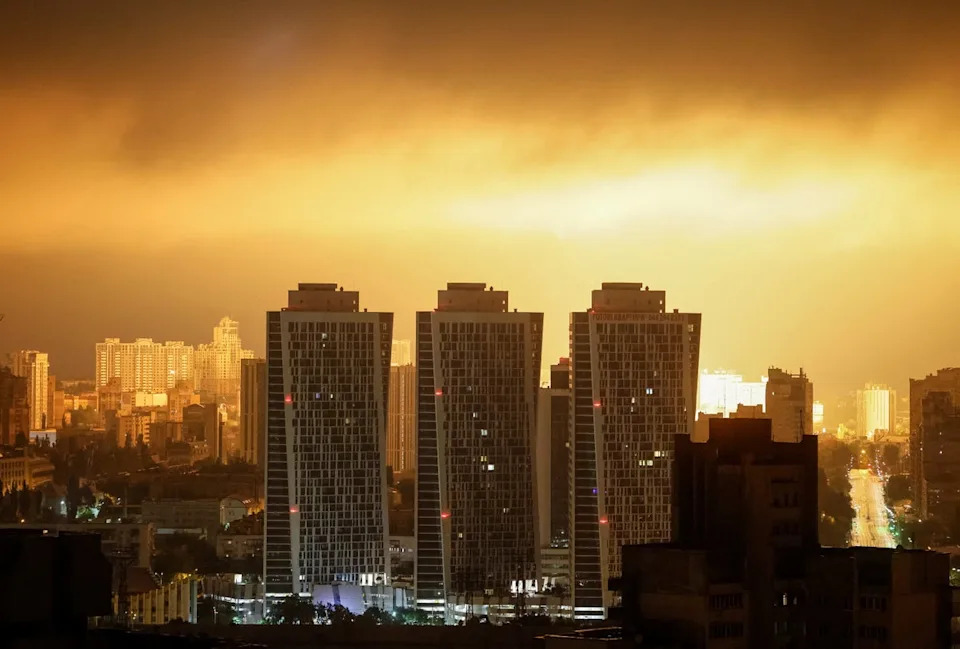
Russia launched the largest aerial strikes of the struggle to date Ukraine over the weekend, killing 4 folks together with a mom and her three-month-old child.
Greater than 800 drones and 13 missiles had been fired at cities throughout Ukraine, together with the capital Kyiv, within the early hours of Sunday 7 September. The strike marked the primary assault of the struggle on the primary Ukrainian authorities constructing, and is the second main assault on the capital inside two weeks.
In response, president Volodymyr Zelensky known as the assault “a deliberate crime and prolongation of the struggle” and known as on the US to offer a “sturdy response” to Russian President Vladimir Putin.
Moscow’s aerial assault on Ukraine is the most recent in a streak of record-breaking aerial strikes over the previous three months. Under, The Unbiased seems at how, and why, Russia has determined to focus on Ukraine’s cities with such devastating pressure.
Assaults elevated from June to August
Russia’s aerial strikes on Ukraine have massively elevated since June, with intense peaks. Figures present that Sunday’s assault was probably the most intense but, with the subsequent closest on 9 July, when Moscow fired 741 drones and missiles.
Putin’s forces have launched 2,022 drones and missiles towards Ukraine to date this month. That’s a rise of 42 per cent in comparison with the primary eight days of July, when Russia had fired 1,418 drones and missiles towards Ukraine.
Within the first eight days of August, Russia fired 683 drones and missiles at Ukraine – lower than the overall of Sunday’s aerial assault. However over the course of the month the strikes intensified, reaching 4,288 in complete by the ultimate day.
July was the deadliest month of the three, with 6,768 drones and missiles dropped throughout the nation, together with in Kyiv and the Sumy, Donetsk and Kherson areas. In June, Moscow fired 5,677 drones and missiles throughout Ukraine.
The information exhibits that whereas drone assaults did barely decline total in August, if the sample to date continues in September, Ukraine is on observe for its heaviest month of shelling but.
Russia has ‘notably’ elevated strikes since Istanbul talks
Based on analysts from the Institute of Warfare Research (IWS), Moscow has “persistently intensified” its strikes because the outset of the struggle in 2022.
They stated Russia’s assaults have “notably accelerated” since Ukraine-Russia bilateral talks in Istanbul on Could 15, 2025. In the course of the negotiations, the international locations agreed to a large-scale prisoner change however failed to succeed in a consensus on ending the combating.
Smoke rising from a authorities constructing after a Russian assault on Kyiv on 7 September (AP)
Their evaluation exhibits Russia has launched 16 mixed strikes consisting of over 400 air targets because the talks. Additionally they famous Sunday’s assault was the fifth mixed strike of over 500 drones and missiles because the August 15 US-Russia summit in Alaska.
Federico Borsari, a Fellow with the Transatlantic Defence and Safety Program on the Middle for European Coverage Evaluation (CEPA), has informed The Unbiased that the Russian military are more likely to have been planning a rise in strikes for at the least a 12 months.

An explosion of a drone lights up the sky over the town throughout a Russian drone and missile strike (REUTERS)
“There have been already indicators that Russia was making an attempt to extend its output by way of property and platforms that they might launch towards Ukraine in 2024,” he stated, including that the rise in drones is an try and make air raids more practical.
“Russia is making an attempt to diversify its strike packages to make them cheaper and obtain a scale of destruction that’s ample to destroy key army targets equivalent to airfields.”
He added that, for greater than three years, Russia was not “very efficient” when it got here to “diminishing the manufacturing capability of Ukraine on the industrial degree”.
The Russian military had additionally didn’t “create a way of panic and worry among the many inhabitants as a way to discredit the federal government and create the situations for much less efficacy on the entrance line,” he stated.
Putin ‘making an attempt to induce panic’ with strikes
Individuals take shelter inside a metro station throughout a Russian drone strike (REUTERS)
Mr Borsari continued that Russia had been compelled to be extra tactical in its goals to extend harm towards crucial Ukrainian infrastructure, whereas additionally concentrating on its manpower.
“Russia is now additionally making an attempt to give attention to extra strategic targets equivalent to army enlistment workplaces, throughout totally different areas of Ukraine,” he stated. “The try right here isn’t just to destroy power crops or different infrastructure, but additionally to instil worry and create a way of panic among the many inhabitants.
“So, growing the psychological results of this struggle on the Ukrainian inhabitants and on the identical time discouraging folks from principally going to enlistment workplaces.”
He stated the psychological results of the strikes might “diminish the flexibility of the Ukrainian forces to recruit”, including: “That is actually a problem for Ukraine in comparison with Russia.”
Evaluation exhibits that whereas Moscow is growing its drone output and ramping up the depth of its assaults, they don’t observe a constant sample. On 8 July, Russia fired 52 drones at Ukraine, adopted by a file 550 the day after. The next day, it fired 322.
Moscow taking ‘on and off days’ strategy to strikes
Marcel Plichta, a former US Division of Protection analyst, recommended that Russia was staggering its massive assaults with an “on and off days” strategy.
“The on day you’ll have a extremely huge and more and more a file breaking assault after which on the off day you’ll have… like 100 drones or 61 drones,” he defined.
“The profit to the big assault is, along with the truth that it grabs headlines, it’s extra more likely to overwhelm Ukrainian air defence and harm the morale of the Ukrainian inhabitants.
“It’s worse to attempt to shoot down 500 drones directly than it’s 200 drones over two nights since you immediately should prioritise. You need to determine the place all of them are and that you must reply to them. That’s a way more difficult scenario.”
Each analysts added that the escalating aerial strikes indicated a ceasefire wasn’t on the playing cards anytime quickly, three years after Putin launched his brutal invasion of the nation.
“Russia has demonstrated that they’re all in on the Shahed as a platform. They’ll tinker with it, they’ll make enhancements, and so they’ll introduce extra difficult variants, however basically they’re all in on this concept of mass drone assaults to accompany their missiles,” Mr Plichta stated.
An Iranian Shahed exploding drone launched by Russia flies by way of the sky seconds earlier than it struck buildings in Kyiv (Copyright 2022 The Related Press. All rights reserved)
“Principally from now till the tip of the battle, you’re going to see a development within the variety of Shaheds getting used. Possibly patterns of their utilization will change once more, however this total quantity used per week, monthly, per 12 months, goes to continue to grow as Russia produces extra and higher Shaheds.”
He added: “In the end the factor that stops Shaheds is a political finish to the battle, not essentially a magic weapon that may shoot down interception fee and even hanging manufacturing amenities.”
Mr Borsari echoed his sentiment, saying: “It’s clear that Russia shouldn’t be fascinated by attaining a ceasefire, at the least based mostly on the situations that the US and Ukraine had been hoping for.”