






After a lifetime spent reciting the everlasting love story of the Taj Mahal, veteran tour information Vishu Das says his religion is shattered.
“The story we now have been telling all these years – what if it seems to be a lie?” he asks, distraught as he seems to be on the monument from a close-by rooftop. His desperation results in a radical suggestion: “Might we not simply run a DNA check on the Taj Mahal?”
The second ends with a bleak conclusion: “We’re spreading a lie.”
It is a scene from Indian director Tushar Goel’s controversial movie “The Taj Story,” launched in October, which challenges the official historical past of one of many world’s most well-known monuments to like.
Within the scene, Das is advancing a idea extensively debunked by historians: that the Seventeenth-century Taj Mahal is just not a Muslim mausoleum, however a Hindu palace, captured by Islamic rulers and “repurposed” for their very own use.
“The Taj Story” is the most recent in a slew of pseudo-historical movies to emerge from India’s multibillion-dollar film trade that critics say search to demonize or erase the nation’s roughly 200 million Muslims and create a historical past dominated by the Hindu majority.
These critics say the venture mirrors the ideology of the ruling Hindu-nationalist Bharatiya Janata Get together (BJP), that has been accused of Islamophobia and stoking tensions between the totally different faiths that coexist on the planet’s largest democracy.
Paresh Rawal, the actor who performs Das in “The Taj Story,” is a former BJP lawmaker, though Goel, the director, instructed CNN the film was not financed or backed by any political social gathering.
The movie’s narrative goes towards the long-held findings of the federal government’s archaeological division and has did not persuade many in India’s media and academia.
“The Taj Story” is a “collage of conspiracy theories,” wrote The Indian Specific newspaper in a overview, including “it merely stirs the pot, mixing reality and fiction to serve an agenda far faraway from historic inquiry.”
Indian journal The Week stated it failed each as “compelling cinema and a propaganda piece.”
The film opens with a two-minute disclaimer stating it’s “a piece of fiction” and that the makers “don’t declare historic accuracy.”
On the field workplace, the response has been lukewarm, with the movie raking in about $2 million from a finances of $1.3 million, Goel stated. However for some, the narrative is resonating.
“The reality can’t be saved hidden any longer,” BJP lawmaker Ashwini Upadhyay instructed native information company ANI. “If anybody tries to cease the film, then extra individuals will watch.”
“It’s about understanding the reality,” Unnati, a cinemagoer who didn’t wish to give her full title, instructed CNN as she left a screening in Mumbai. “We now have been misguided all this time. We by no means knew our personal historical past.”
CNN has contacted the BJP for response.
A logo of affection
Rising from the banks of the Yamuna River – sacred to India’s Hindus – the white marble Taj Mahal is the Seventeenth-century embodiment of an emperor’s love for his spouse.
Commissioned by Shah Jahan in reminiscence of his spouse Mumtaz Mahal, the UNESCO World Heritage Website is India’s most visited monument, drawing over seven million individuals yearly.
Inside its gardens, {couples} search inspiration from the love story it immortalizes. Past its partitions, its picture has change into a common image of India itself, gracing the whole lot from journey posters to marriage ceremony invites. For generations, it has represented a narrative of devotion, unparalleled artistry, and the nation’s pluralistic previous.
“The Taj Story” seeks to dismantle that narrative.
The 165-minute courtroom drama facilities on Das, a tour information performed by veteran Bollywood actor Rawal. For 25 years, Das has regaled vacationers with the legendary love story, however this public efficiency masks a deep-seated disaster: he’s a person who can now not consider the story he sells.
His rising doubts immediate him to file a public curiosity litigation difficult the monument’s official historical past, thrusting the movie into its central debate: was the Taj Mahal constructed by Shah Jahan, or was it a “repurposed” Hindu palace, as a revisionist idea common in some Hindu nationalist circles claims?
Within the ensuing courtroom battle, the evidence-based arguments of historians and archaeologists are persistently drowned out by Das’s fiery speeches, which decry supposed “leftist agendas” and the “over-romanticising” of Mughal historical past.
“This movie is in regards to the historic information of the Taj Mahal,” Goel instructed CNN. “Why hasn’t it been taught in our textbooks?”
He added the movie is “not about Hindus or Muslims,” but Muslim characters are solid as antagonists – from a rival tour information who opposes Das’ marketing campaign, to mobs that assault his youngsters and vandalize his residence.
It’s a sentiment actor Rawal agrees with. He instructed CNN that the movie “doesn’t talk about any religion” and “speaks about information.”
He added: “We’re speaking in regards to the training board and why the historians have performed soiled and all that we’re speaking about… It’s all information in entrance of me… And I’ve verified with one or two historians, good and trustworthy historians.”
Rewriting the previous
The controversy surrounding “The Taj Story” comes alongside a broader try and redefine India’s previous.
For the reason that BJP got here to energy in 2014, critics say, there was a gentle push to rewrite historical past by official channels, significantly focusing on India’s Mughal interval, when Muslim sultanates dominated over what grew to become one of many world’s wealthiest empires, till the arrival of European colonialism led to its eventual decline and collapse.
Textbooks have been rewritten to downplay the historical past of India’s Islamic rulers, cities and streets with Mughal-era names renamed, and Muslim properties demolished by authorities for unlawful encroachment on authorities land and as punishment for alleged rioting.
“The Taj Story” narrative additionally carries echoes of the controversy surrounding the Babri Masjid in Ayodhya, a mosque that was demolished by Hindu hardliners in a 1992 assault over beliefs it was constructed on the location of a Hindu temple. The constructing’s destruction sparked a few of the worst violence India has seen since independence and has been on the coronary heart of a fiery and divisive debate about identification and historical past within the ensuing many years.
Individuals on the day of judgement of Ram Mandir and Babri Masjid in Ayodhya, India, on November 9, 2025. – Pankaj Nangia/India In the present day Group/Getty Photographs
Whereas supporters champion these modifications as a restoration of India’s pre-Islamic heritage, critics condemn them as a deliberate erasure of the nation’s pluralistic historical past.
It’s not the primary time the Taj Mahal has change into a flashpoint for political and historic disputes.
In 2017, it was conspicuously absent from a tourism booklet revealed by the Hindu-nationalist authorities of Uttar Pradesh, the state it’s situated in. The omission of India’s most well-known landmark sparked backlash, which officers dismissed by claiming the booklet was by no means supposed for public distribution.
5 years later, a politician with the ruling BJP filed a court docket petition demanding that 22 sealed rooms throughout the monument be opened to seek for proof of a Hindu temple. The authorized problem was primarily based on the long-debunked “Tejo Mahalaya” idea – a fringe declare popularized by right-wing writer P.N. Oak within the Nineteen Eighties that the mausoleum was initially a Hindu temple. The Archaeological Survey of India has persistently rejected this idea, stating there isn’t any proof to help it.
Whereas “The Taj Story” doesn’t explicitly endorse the Tejo Mahalaya idea, its promotional poster, which sparked controversy, depicts the Hindu god Shiva rising from the tomb.
Historian Swapna Liddle stated the interval throughout which the Taj Mahal was constructed is “very properly recorded.”
She added: “The Mughals had been a really bureaucratic state. They left behind a variety of paperwork, and we now have all this. This sort of a venture was an enormous venture.”
Bollywood as a mirror
For almost a century, Bollywood has held a mirror to Indian society, the plotlines of the world’s most prolific film trade reflecting the altering tides of an unlimited, growing nation.
Hindi cinema as soon as mirrored secular, democratic values championed by India’s founding fathers. However many critics say the trade has veered towards the fitting over the previous decade – coinciding with the populist rule of Prime Minister Narendra Modi and his BJP.
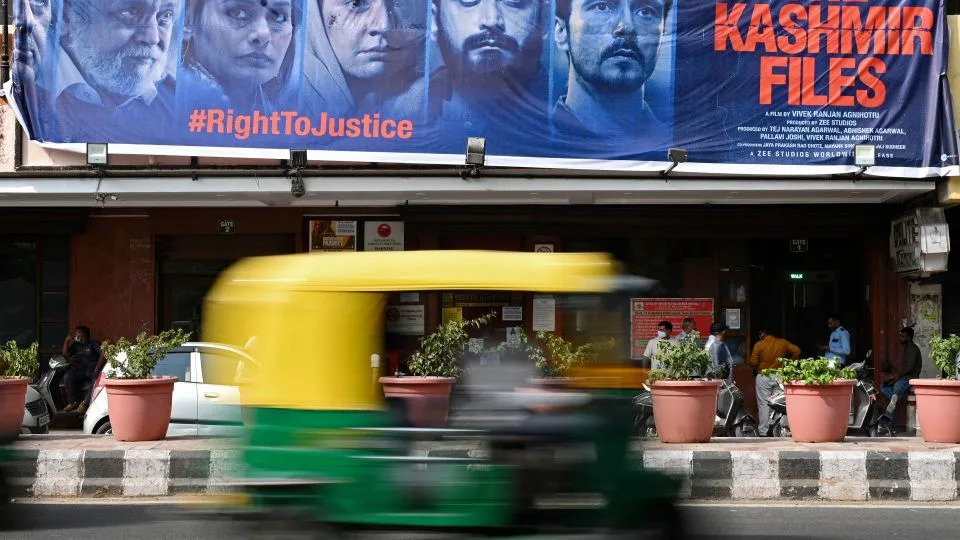
“The Kashmir Information” of 2022 and “The Kerala Story” of 2023 are earlier high-profile film releases that had been criticized for vilifying Muslims, perpetuating unfavorable stereotypes, worsening non secular tensions and distorting historic information.
In the meantime, movies perceived as disrespecting Hindu traditions have confronted extreme penalties. The movie “Annapoorani” (2023) was pulled from Netflix after right-wing teams protested its depiction of a Brahmin girl – a member of the priestly Hindu caste – cooking and consuming meat. The historic epic “Padmaavat” (2018) triggered violent nationwide protests from Hindu teams who alleged it distorted historical past by suggesting a romantic hyperlink between a revered Hindu queen and an invading Muslim sultan.


An auto rickshaw strikes previous a banner of Bollywood film ‘The Kashmir Information’ put in outdoors a cinema corridor within the previous quarters of Delhi, on March 21, 2022. – Sajjad Hussain/AFP/Getty Photographs
These movies, historians argue, are a part of a broader marketing campaign to redefine India’s nationwide identification by elevating its Hindu heritage and vilifying its Muslim previous.
Historian Liddle stated that for many individuals, their “common thought of historical past” comes straight from common tradition.
She stated that regardless that these are “fictionalized accounts,” they’ve an outsized “impression and affect” as a result of audiences sincerely consider them to be “precise historical past.”
The Taj Mahal itself stays unchanged by the controversy.
Because it has executed for hundreds of years, the marble gleams throughout the Yamuna River, a silent testomony to symmetry and style. However the story India tells about it’s fracturing.
“We’re seeing a spate of flicks that appear to be very consciously projecting historic Muslim figures as villains,” Liddle stated.
“This clearly aligns with a political agenda, and that may be a type of mischief that could be very, very harmful.”
For extra CNN information and newsletters create an account at CNN.com