






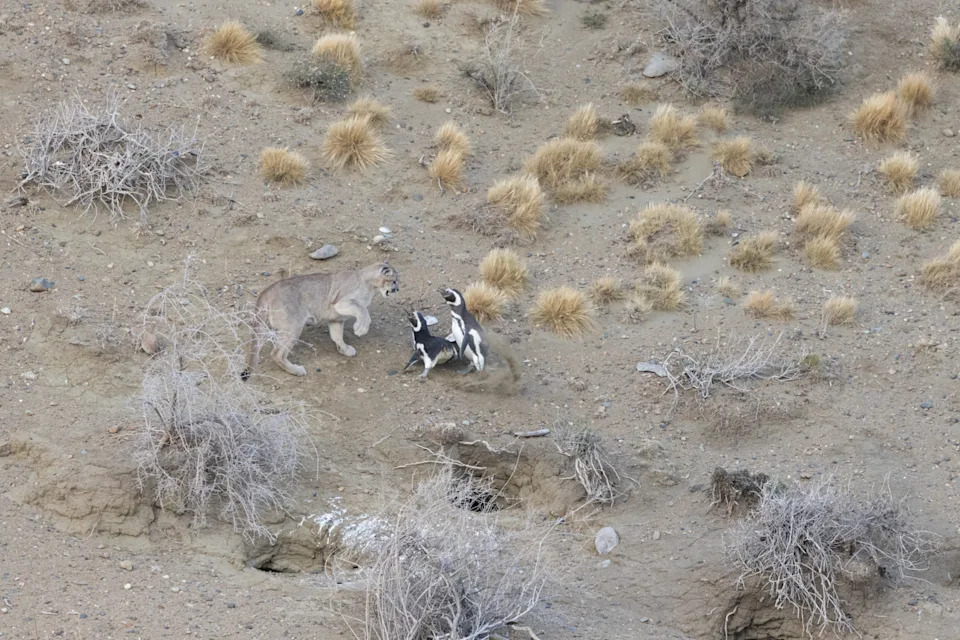
For many years, pumas preyed on sheep from ranches alongside Argentina’s coast, and ranchers hunted them—closely.Pumas disappeared from the panorama. Then, in 2004, conservationists established Monte León Nationwide Park within the area. As anticipated, as soon as the looking stopped, the massive cats got here again. And once they returned, they discovered a brand new participant of their previous neighborhood: Magellanic penguins.
What scientists didn’t anticipate was that not solely would pumas prey on penguins—however that the birds’ seasonal arrival would reorganize how these famously solitary cats transfer, work together, and hunt throughout the panorama. A brand new research revealed in the present day within the journal Proceedings of the Royal Society B paperwork this shift in puma habits for the primary time and challenges our assumptions about what occurs when massive predators return to an ecosystem.
“Once we begin to rewild the land, the species which might be coming again would possibly discover a system that may be a bit totally different from the one which they used to inhabit 100 years in the past—they usually adapt to it,” says Emiliano Donadio, science director on the Fundación Rewilding Argentina and a coauthor of the research.
(How a penguin ‘bloodbath’ led to historic new protections in Argentina)
Digital camera traps unveil puma predation
The researchers didn’t initially got down to research this distinctive predator-prey relationship. Lead creator and ecologist Mitchell Serota, then on the College of California Berkeley, was working with Fundación Rewilding Argentina to check how wildlife responds when human pressures are faraway from former ranchlands. “I went all the way down to Patagonia to know restoration outcomes broadly. The penguins weren’t the unique focus in any respect,” he says.
In 2023, Serota and his colleagues reported that the massive cats had been really feeding on the gawky birds. “That interplay was identified, however we thought it was minor,” he says. “Perhaps only a handful of people.”
The staff had put in 32 digital camera traps throughout the park and tracked 14 grownup pumas (Puma concolor) with GPS collars between September 2019 and January 2023. Combining that information with subject observations, the researchers shortly realized pumas had been snacking on penguins rather more incessantly than anticipated.
“We had been getting repeated detections of pumas proper across the penguin colony,” Serota remembers. “That’s when it turned clear this was not a aspect be aware. It was one thing shaping how these animals had been utilizing the panorama.”
A brand new meals internet takes form
As a result of Magellanic penguins (Spheniscus magellanicus) spend a lot of their lives at sea, they’re uncommon prey for a big terrestrial carnivore whose weight loss program is usually made up of land mammals, comparable to deer, guanacos (family of llamas), and hares. However throughout their breeding season—roughly September by way of April—the seabirds huddle on land in massive numbers. At Monte León, greater than 40,000 breeding pairs nest alongside a shoreline of about two kilometers lengthy.
(What Magellanic penguins are instructing us about survival)
For a puma, whose territory can cowl tons of of sq. kilometers, this creates an odd scenario: a particularly considerable meals supply, concentrated in a really small space, and obtainable solely a part of the yr. The staff discovered that the inhabitants density remained comparable—round 13 cats per 100 sq. kilometers—whether or not penguins had been current or absent. So, penguins didn’t create extra pumas, however reorganized how these cats share area.
Penguin-eating pumas, it seems, behave fairly otherwise from those that choose different diets in Patagonia. The research discovered that bird-eating large cats shared the identical space rather more incessantly than non-bird-eating ones and weren’t attacking one another as usually as one would anticipate. “In different phrases, penguin-eating pumas had been fairly tolerant of the presence of each other,” says Donadio, who can be a Nationwide Geographic Explorer.
Such tolerance was a shock, given the pumas’ loner stereotype. In Patagonia, these large cats are out within the open, as they’re the highest predator. “Not like Africa, they don’t must scrum collectively to take down prey twice or thrice their dimension. And in contrast to North America, there are not any grizzly bears, black bears or wolves, so these cats should not sneaking round within the bushes at evening like they’re up right here,” says Jim Williams, who labored for many years as a biologist with Montana Fish, Wildlife and Parks and wrote concerning the relationship between the seabirds and large cats in his guide Path of the Puma.
In Monte León, pumas usually go to the penguin colony within the evenings to hunt. Gonzalo Ignazi
To a point, it is smart that pumas pounced on the brand new meals supply, as penguins are low-risk prey. “Massive cats—lions, panthers, cougars, pumas—all the time prey on essentially the most considerable and susceptible meals sources obtainable,” says Williams, who was not affiliated with the present research. “That’s not surprising from an ecological perspective or a pure habits, however it’s for individuals who do not know that penguins and pumas overlap,” he provides.
However the habits modifications are shocking. “We have a tendency to think about pumas as extraordinarily aggressive and illiberal,” Donadio says. “However when meals is considerable and concentrated, there’s no must defend it. They turn into extra socially tolerant,” he provides.
(What one photographer realized after spending practically a yr with pumas)
Open questions
Donadio says that, up to now, surveys recommend the penguin colony has remained steady and even elevated for the reason that park was created. What stays unsure is how the penguin-driven modifications in puma habits ripple by way of the remainder of the ecosystem—particularly to guanacos, Patagonia’s dominant herbivore, and the pumas’ main conventional prey.
Regardless of the behavioral shifts documented within the research, some vital questions stay. The researchers nonetheless don’t know what number of penguins particular person pumas kill, making it troublesome to evaluate the long-term impression of predation onthe colony, though penguin numbers at Monte León seem steady or rising up to now. Nor can they but decide whether or not the excessive puma density is a brief or a long-term function of the ecosystem.
Additionally, researchers nonetheless have to determine the broader ecological penalties of penguin-driven modifications in puma habits. “We all know that the penguin colony has modified the place, when, and the way pumas receive their meals, however the subsequent step is to know the ecological implications of that change,” Serota says.
For now, the puma habits findings show that when nature is given area, it doesn’t all the time look again—it improvises. “Restoration doesn’t imply going again to some historic snapshot,” Serota says. “Species are returning to ecosystems which have modified dramatically. That may create completely new interactions.”
The nonprofit Nationwide Geographic Society, dedicated to illuminating and defending the marvel of our world, funded Explorer Emiliano Donadio’s work. Study extra concerning the Society’s help of Explorers.