






Opposite to widespread depictions of bee nests as giant, intricate hives that dangle from bushes, nearly all of bee species — about 90% — are literally solitary and construct their nests within the floor or inside rotting logs and the stems of vegetation.
However researchers just lately found what is probably probably the most peculiar nesting spots: Inside a limestone cave on the Caribbean island of Hispaniola, a hoard of fossilized bones — some from now-extinct animals — was residence to tiny historical bee nests constructed throughout the empty tooth sockets. It’s the first time bees have been recorded utilizing bones to nest and lay eggs, based on a examine printed Tuesday within the journal Royal Society Open Science.
“It was very shocking, since you by no means discover invertebrates there — you discover snails, however you don’t discover bugs,” mentioned lead writer Lázaro Viñola-López, a postdoctoral researcher on the Subject Museum of Pure Historical past in Chicago. “Often what you discover on this cave are rodents, birds, like all that fauna. So, discovering proof of historical bees in these cave deposits was very thrilling. The primary time we have now that within the Caribbean.”
The findings assist to fill a spot within the fossil document since all different bee fossils described within the Caribbean had been found inside amber and are a lot older, relationship again round 20 million years, Viñola-López defined.
A hoard of fossilized bones was residence to tiny historical bee nests constructed inside empty tooth sockets. – Courtesy of Lazaro Viñola López
The examine authors imagine that fossils housing the bee nests date again to round 20,000 years in the past and will make clear how bees have tailored to their atmosphere, even within the historical previous.
“There’s little or no recognized concerning the ecology of most of the bees on these islands,” Viñola-López mentioned. “This reveals that the variety of nesting processes of bees is definitely actually huge and typically expands previous what we predict is regular. … It additionally tells that we have now to, once we put together specimens, look nearer for all of the issues that may get preserved inside these ones, which may present very unusual behaviors of species that we predict that we perceive comparatively nicely.”
A fossil inside a fossil


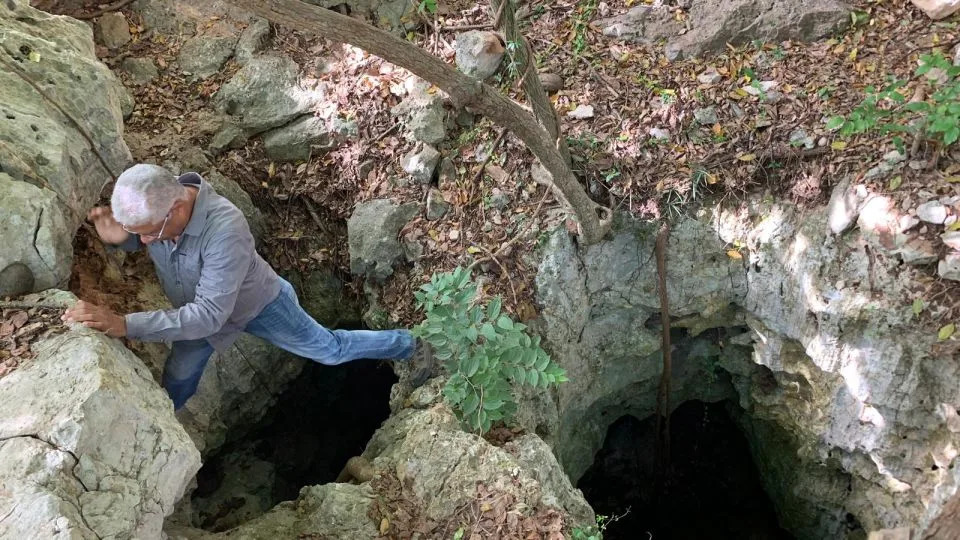
Paleontologist Juan Almonte Milan first discovered the cave on the island of Hispaniola. – Courtesy of Lázaro Viñola-López
Viñola-López was exploring the cave with colleagues in the summertime of 2022, searching for specimens to review for his doctoral program on the College of Florida and the Florida Museum of Pure Historical past. The cave itself holds a narrative, because it comprises layer upon layer of fossils from greater than 50 species, together with rodents, birds and reptiles.
The examine authors imagine a household of barn owls as soon as lived within the cave and coughed up the bones of their prey, which finally fossilized. The owls might need remained within the cave for generations, ensuing within the accumulation of hundreds of fossils. Different species, comparable to tortoises and crocodiles, may have fallen into the cave — which has an about 8-meter drop at its entrance — and finally died after they couldn’t climb again out. The atmosphere, protected against the surface climate, served to protect the specimens additional.
However when Viñola-López took a more in-depth take a look at the fossils, he seen one thing odd — dust lining the insides of the tooth sockets reminded him of how wasps would possibly construct their cocoons.
The analysis group collected fossils of various species of vertebrates. – Courtesy of Lázaro Viñola-López
After performing CT scans, X-ray know-how that creates detailed 3D imaging, the authors had been in a position to decide that the small nests had been product of mud and belonged to a bee. Whereas wasp nests are created from a mixture of saliva and chewed plant fibers, the nests from the cave had been easy on the within, indicative of a bee’s nest-building course of, which makes use of compacted dust and a secreted waxy substance that coats the within of the partitions.
“It is a very attention-grabbing document as a result of normally for bees, typically they like shaded areas, a few of them could be nocturnal, however nesting in a cave is a really, very unusual conduct,” Viñola-López mentioned. There is just one different recorded occasion of a burrowing bee nesting inside a cave, based on a launch from the Florida Museum of Pure Historical past. “We additionally know that it isn’t one specimen that did it. Even in a single gap of a mandible, there are as much as six generations of bees coming again to that very same single gap. … So plainly it was most likely a big communal nesting.”
Nonetheless, whereas the muggy cave preserved the fossils, the situations weren’t best for preserving the our bodies of any bugs. The authors had been due to this fact unable to find out which species of bee was nesting within the cave. It is usually unclear whether or not the nests had been constructed by an extinct bee species or one that’s nonetheless round in the present day. For now, their nests are the one named specimen, now often called Osnidum almontei, after Juan Almonte Milan, the scientist who first found the cave, based on the examine.
“It is a good piece of labor introduced by these researchers that provides to the document of ‘hidden biodiversity.’ Because of this though no physique fossils of bees had been recovered from the cave, their hint fossils (aka ichnofossils) are diagnostic of soil bees. These bee cells inform us concerning the atmosphere and ecosystem by which they lived,” mentioned Stephen Hasiotis, a geology professor on the College of Kansas, Lawrence, whose analysis focuses on paleontology and ichnology, or the examine of hint fossils. Hasiotis was not concerned with the brand new examine.
“The bees possible constructed their nests within the cave soils as a result of the humidity throughout the cave and soils would have been practically fixed,” he added in an e mail. “The realm was possible protected against heavy rains and floodings, to not point out additionally being protected against many potential predators and omnivores of assorted sizes cohabiting the soils by which they burrowed.”
Viñola-López mentioned he hopes to return to the world to do additional surveys that will assist decide whether or not the bees are nonetheless within the space — and if this conduct is present in different caves and on different islands.
The bee nests have been categorized as Osnidum almontei, named after Juan Almonte Milan. – Courtesy of Lázaro Viñola-López
“This discovery is doubly shocking, as a result of trendy bees aren’t recognized to make use of bones for his or her nesting, nor are they recognized to nest in caves. However these fossil bees brooding chambers in sediment-filled elements of bones inform us that their makers may do each, which is thrilling to know,” mentioned Anthony Martin, a professor of follow within the division of environmental sciences at Emory College in Atlanta. Martin is the writer of the 2023 ebook, “Life Sculpted: Tales of the Animals, Crops, and Fungi that Drill, Break, and Scrape to Form Earth.”
“Bugs have been adapting to adjustments of their environments for nearly 400 million years, and ground-nesting bees have been round for concerning the final 100 million years of that point,” mentioned Martin, who was not concerned with the brand new examine. “So this thrilling fossil discovery of bees nesting in bone cavities, and in caves, serves as a great reminder that in relation to evolution, bees will carry on being the bees they should be.”
Taylor Nicioli is a contract journalist based mostly in New York.
Join CNN’s Surprise Idea science publication. Discover the universe with information on fascinating discoveries, scientific developments and extra.
For extra CNN information and newsletters create an account at CNN.com