






The pit is believed to have been from a time of battle “between the Saxon-run kingdom of Mercia and the dominion of East Anglia, which was conquered by the Vikings in round 870 [CE].”
A burial pit from the ninth century CE was found by Cambridge College archaeologists and college students throughout a coaching dig, the college introduced in an early February assertion.
The dig occurred at Wandlebury Nation Park on the outskirts of Cambridge, and was led by Dr. Oscar Aldred from the Cambridge Archaeological Unit (CAU).
The pit is believed to have been from a time of battle “between the Saxon-run kingdom of Mercia and the dominion of East Anglia, which was conquered by the Vikings in round 870 [CE],” the assertion defined.
Archaeologists surmised that the pit contained the stays of at the very least 10 folks, however solely 4 full skeletons “in positions suggesting they had been tied up.”
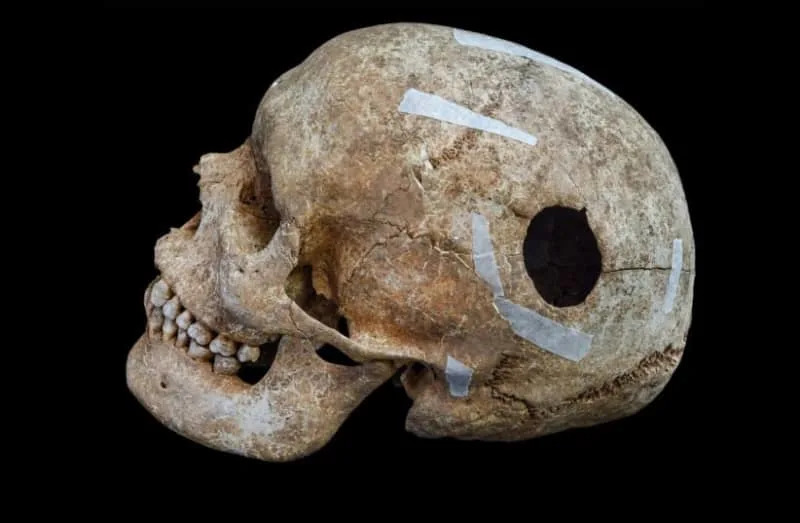
As well as, the stays additionally included a decapitation, and “a person nicely over six foot in stature – extraordinarily tall for the time – with a trepanned head.”
Trepanned cranium, discovered throughout a coaching dig by Cambridge College archaeologists and college students at Wandlebury Nation Park on the outskirts of Cambridge, UK, February 4, 2026. (credit score: Cambridge Archaeological Unit/David Matzliach)
Trepanning is an historic surgical process, the place medical practitioners would drill a gap by a residing human’s cranium, to deal with intracranial illnesses or launch stress.
Curator of the Duckworth Collections at Cambridge College Dr. Trish Biers theorized that the person’s peak might have been as a result of a tumor affecting his “pituitary gland and brought on an extra of development hormones.”
Biers additional famous that if that had been the case, the person would have been plagued with complications “that the trepanning might have been an try and alleviate.”
Different stays belonged to younger males aged 17-24
The remaining bones included “a cluster of skulls with out clear accompanying our bodies and a ‘stack of legs,’ which researchers will try and “refit” with the intention to verify the variety of stays.
Archaeologists dominated the stays as belonging to younger males between the ages of 17-24, who had been thrown into the pit “with out care,” however famous that there isn’t sufficient proof to counsel that the stays had been victims of battle.
“These buried might have been recipients of corporal punishment, and which may be related to Wandlebury as a sacred or well-known assembly place,” Aldred defined, noting that the various physique components might have been “displayed as trophies” earlier than being gathered up into the pit.
“We don’t see a lot proof for the deliberate chopping up of a few of these physique components, so they might have been in a state of decomposition and actually falling aside once they went into the pit.”
“I’d by no means have anticipated to search out one thing like this on a scholar coaching dig. It was a surprising distinction to the peaceable web site of Wandlebury,” Grace Grandfield, a Cambridge undergraduate who took half within the dig, mentioned.
“A number of of the people we uncovered had been an identical age to me, and it was a sobering expertise to determine ever extra disarticulated bones and understand the extent of the struggling that had taken place.”
“I had by no means encountered human stays on a dig, and I used to be struck by how shut but distant these folks felt,” third-year archaeology undergraduate Olivia Courtney echoed. “We had been separated by just a few years in age, however over a thousand years in time.”