


Marom argued that the strike reshaped regional alignments and revealed weaknesses in Iran’s menace posture.
Former Israel Navy chief, V.-Adm. (res.) Eliezer “Chayni” Marom stated Iran made a sequence of “errors” in the middle of the preventing, led by what he described as a “grave strategic mistake” when Tehran launched a direct assault on Israel from Iranian territory, in an interview with 103FM on Sunday.
Marom argued that the strike reshaped regional alignments and revealed weaknesses in Iran’s menace posture.
The previous Israel Navy chief stated the assault marked a turning level as a result of it stripped away ambiguity about Iran’s position and compelled regional actors to reassess their pursuits. “The start of the chain is April 14,” he stated, referring to the night time Iran launched drones and missiles instantly at Israel.
He argued that firing instantly from Iran broken Tehran’s deterrence and elevated its publicity, significantly as a result of a lot of the barrage was intercepted.
Iran had “promised hell,” Marom stated, however as an alternative revealed what he characterised as a restricted skill to translate threats into sustained battlefield impression.
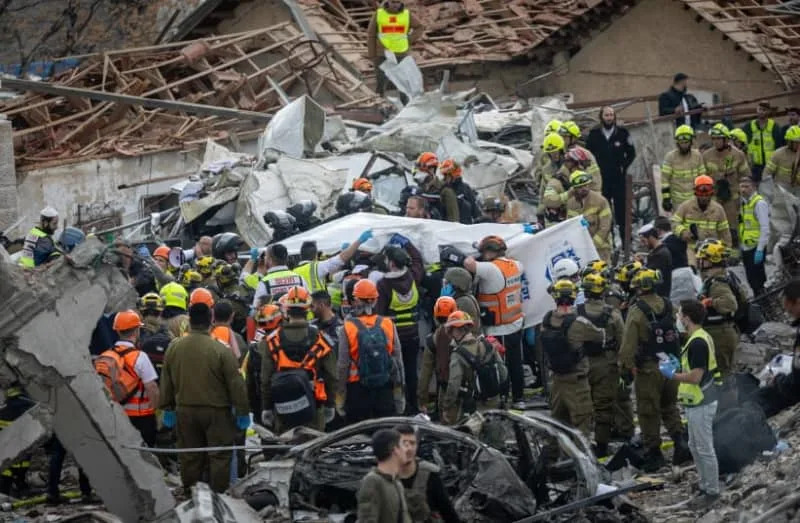
The scene the place a ballistic missile fired from Iran hit Guess Shemesh, central Israel, inflicting heavy injury, March 1, 2026 (credit score: YONATAN SINDEL/FLASH90)
Strike was Iran’s first direct assault on Israel
The Jerusalem Submit reported on the time that the strike was Iran’s first direct assault on Israel and that Israel, with companions, intercepted the overwhelming majority of the greater than 300 drones and missiles launched.
Marom additionally argued that Iran’s posture towards surrounding states has eroded its standing within the area, saying Tehran has “burned” relationships and “made itself a nasty title” throughout neighboring nations. He framed the result as a clearer regional image of “who’s towards whom,” following repeated Iranian assaults and threats linked to the broader battle atmosphere.
Saying he was talking cautiously, the previous Israel Navy chief assessed that Iran’s skill to ship on its threats shouldn’t be as in depth as many Israelis believed. On the similar time, he harassed that adversaries shouldn’t be underestimated, even when their efficiency seems weaker than anticipated.
In different remarks in latest weeks, Marom has warned that even when Iran’s present management had been to fall, the result may not be democratic and will as an alternative produce a military-led authorities dominated by the Islamic Revolutionary Guard Corps. He stated a management vacuum after regime collapse usually produces chaos, significantly with no single unifying determine.
Marom’s feedback got here amid continued debate in Israel over how one can assess Iran’s remaining capabilities, the sturdiness of its alliances, and the dangers of escalation if diplomacy collapses. He has additionally argued that the following part might hinge on whether or not negotiations succeed or fail, warning that the window for a negotiated consequence might be narrowing.
The previous Israel Navy chief concluded by cautioning that even when an opponent seems uncovered, strategic surprises stay attainable, and “after each regime falls, there’s nearly all the time chaos.”