


SAUGATUCK, MI — The spill was hidden in plain sight.
For almost a month, tiny white plastic pellets lined the shoulder of I-196. They clung to guardrails and picked up in drifts alongside a bridge over the Kalamazoo River, nearly completely mixing into the wintery roadside panorama following a semi-trailer crash.
However it wasn’t simply soiled snow. It was tens of 1000’s of kilos of commercial plastic known as “nurdles” which sat unnoticed subsequent to a Lake Michigan tributary for 3 weeks whereas the Division of Surroundings, Nice Lakes and Vitality (EGLE) — the company accountable for defending Michigan waters — didn’t even know they had been there.
A thaw ultimately uncovered the issue — however not earlier than plastic made its approach into the river, the place the pellets pose threat to fish and wildlife and may break down into waterborne chemical substances.
Cleanup is underway, however environmental advocates say the incident highlights a spot in laws and spill response round industrial microplastics which trucking providers are shifting en masse across the nation’s highways — generally in hazardous climate.
“Why did it take so lengthy for EGLE to get notified and rapidly begin initiating some form of corrective motion?” requested Artwork Hirsch, a former environmental guide and who co-founded of the Michigan Microplastics Coalition in 2023.
“They might have been extra aggressive in addressing this, as a result of it in the end ended up polluting the Kalamazoo River,” Hirsch stated.
What precisely occurred?
At 3 p.m. on Jan. 27, a semi-trailer hauling 48,000 kilos of tiny polystyrene plastic pellets carried out a “defensive maneuver” to keep away from stopped autos and crashed into the guardrail alongside northbound I-196, spilling its load on the south finish of a river bridge.
The climate was unhealthy. It was a whiteout blizzard and emergency providers had been busy responding to quite a few freeway crashes.
The trailer, pushed by the Iowa trucking agency Quest Liner, part of the McCoy Group, spilled 28,000 kilos of plastic from chutes which can be speculated to dispense pellets at manufacturing services the place they’re melted and shaped into plastic merchandise.
Images from the scene present giant, apparent piles of plastic below the trailer, which native first responders and dispatch logs point out had been partially eliminated by loaders. In accordance with EGLE, the trailer was then towed 11 miles north to a towing yard off M-40 at Exit 49 in Holland.
The trailer continued to spill pellets the complete approach.
“We did see pellets in low to reasonable focus alongside that entire stretch because it was simply form of pouring out as they went alongside the street,” stated Eddie Kostelnik, an analyst in EGLE’s rising pollution part.
Quest Liner truck spills plastic pellets
There was nonetheless an estimated 5,000 kilos of pellets contained in the trailer when the tow started, stated Kostelnik. These which spilled onto the freeway shoulder didn’t all keep there. Many turned enmeshed in roadside gravel and grass, however some migrated into tributaries and drains.
Twenty-three days after the crash, on Feb. 19, Youngs Environmental, a Quest Liner contractor, contacted EGLE to ask about cleanup.
The inquiry was a shock to EGLE workers, who scrambled out to the positioning to evaluate the scope of spilled plastic. They discovered an enormous pile subsequent to a twisted, damaged guardrail on the south finish of the freeway bridge, pellets on the bridge deck and the tops of bridge pillars, in wetlands alongside the riverbank, within the river itself, and unfold alongside the embankment on the north finish of the bridge. Pellets littered the roadside for miles.
Silt fencing was positioned across the massive pile.
On Feb. 25, EGLE notified the general public with a press launch concerning the spill. The following night, the Michigan Division of Transportation (MDOT) closed the northbound lands to take away the roadside pellet pile, which was estimated at about 28,000 kilos.
On Feb. 26, EGLE issued a violation discover to Quest Liner, calling the pellet discharge a “persevering with” violation of state water high quality legislation that prohibits the discharge of floating or settleable solids into state waters.
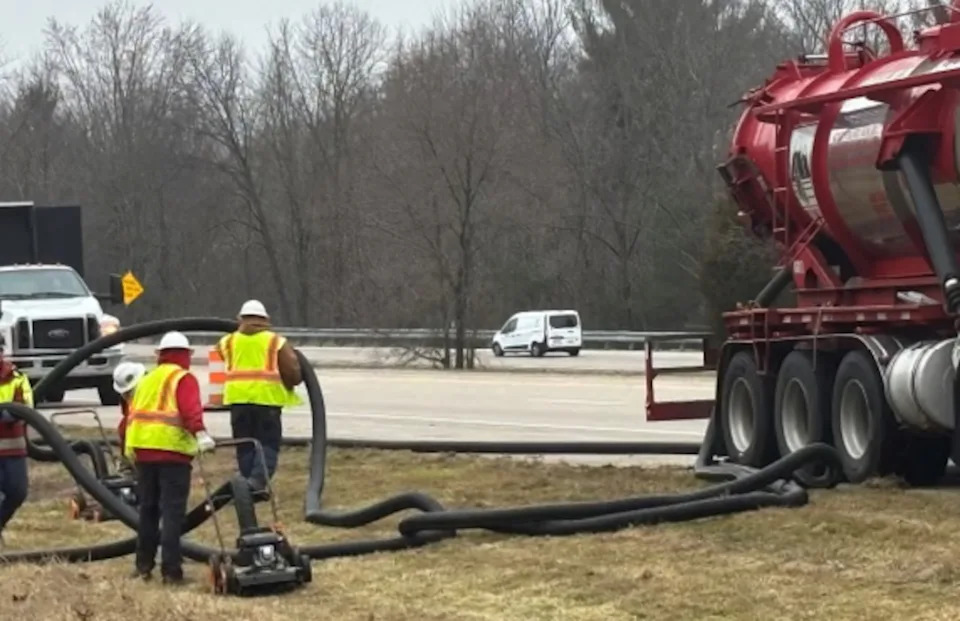
Since then, crews have been sucking pellets from the shoulder and ditches utilizing a modified push-mower assortment system connected to hoover vans. Work has been sluggish and depending on dry climate. Catch basin inserts have been put in to forestall pellets from washing into storm drains. Vegetation alongside the river has been left in place in some areas as a result of it’s appearing as a barrier to additional motion.

MDOT nurdle spill cleanup
Early dive surveys recommend restricted accumulation on the river backside close to the crash website, however EGLE remains to be evaluating whether or not pellets might have floated or migrated farther. The crash is simply upriver from Lake Michigan, the place nurdles are recognized to seek out their approach into seashores.
Of the truck’s pellet load, roughly 33,000 kilos have been recovered and 15,000 kilos stay unaccounted for, Kostelnik stated.
What prompted the delay in cleanup?
Technically, the state knew concerning the spill the day it occurred.
In accordance with EGLE, Quest Liner informed MDOT concerning the spill instantly. Nevertheless, the corporate wasn’t required to inform environmental regulators as a result of the pellets aren’t thought-about a “hazardous” materials that may immediate an emergency cleanup.
The state transportation company didn’t subsequently notify EGLE concerning the spill — though it did challenge a building allow to Youngs Environmental to take away the plastic pile.
It’s not precisely clear why nobody at MDOT took the step of telling its sister company concerning the spilled plastic. John Richard, a spokesperson for MDOT, stated telling EGLE isn’t the company’s duty and that cleanup wasn’t possible till the snow melted anyway.
“It’s at all times as much as the personal firm that’s accountable for the incident to contact the entire applicable personnel,” Richard stated.
“The street company, on this case MDOT, has no concept what or how a lot anybody is hauling,” Richard stated. “Our precedence is to securely clear the crash scene and get the street again open as quickly as doable. With the piled-up snow, the blizzard, the crash and the nurdles trying equivalent to snow, it was unimaginable to inform if something was spilled not to mention how a lot.”
Industrial microplastic spill impacts Kalamazoo River
Elaine Sterrett Isley, director of the Saugatuck Coastal Dunes Alliance, agreed that the snow cowl was a sensible issue which restricted early response — but in addition thinks {that a} three-week delay in telling EGLE is one other instance of “these pretty state silos.”
“When the crash occurred, I’m assuming the responding events didn’t perceive why that is an environmental drawback,” Isely stated.
“They simply noticed it as litter.”
Pellets can breakdown into waterborne chemical substances
Microplastics are definitely litter — however of a extra pernicious kind.
Like PFAS earlier than them, microplastics are thought-about an “rising” contaminant. Scientists and regulators are nonetheless working to grasp their habits, dangers and handle them. Final week, the EPA proposed to checklist them as consuming water contaminates, which can ultimately result in new controls. Laws in Michigan is proposing a analysis plan and EGLE has begun focused floor water sampling.
In contrast to chemical substances, plastics should not a single substance. They embrace 1000’s of various polymers and components that may change over time as they break down within the surroundings.
In Saugatuck, Quest Liner spilled STYRON 484 polystyrene pellets, a sort of commercial resin made by Americas Styrenics (AmSty) of Texas that’s utilized in packaging and molded shopper items. Precisely what they might have turn out to be isn’t recognized. Neither the state nor the trucking agency have disclosed the place the cargo originated or the place it was headed.
Yoorae Noh, a researcher at Michigan State College’s College of Packaging, stated the pellets don’t merely disappear as soon as they enter the surroundings. Plastic degrades over time, and the speed depends upon components like temperature, daylight and water circumstances.
In summer season warmth, polystyrene pellets “can dramatically degrade into byproducts and may emit unstable natural compounds,” stated Noh, who has run lab assessments on pellets from the Saugatuck spill to assist EGLE work out their habits within the river.
Even earlier than they break down, the pellets can pose dangers. Fish and birds can mistake them for meals. As soon as ingested, they block digestive techniques or accumulate in tissues. Over time, plastics may also take up and transport different contaminants within the water.
Industrial microplastic spill impacts Kalamazoo River
Cleanup, Noh stated, is inherently restricted.
Massive piles may be eliminated. However as soon as pellets unfold into soil, vegetation, storm drains and waterways, full restoration turns into unlikely.
The spill has been an eye-opener for EGLE. “Simply making an attempt to determine what’s the easiest way to answer these kinds of spills is definitely one thing that we’re studying as we go,” stated Kostelnik.
New protocols are wanted, say advocates
Advocates say the spill revealed a blind spot in how pellets are regulated and the way duty for monitoring is split amongst businesses.
“There’s no protocols proper now in Michigan,” stated Hirsch, who argued that state stormwater management laws must be up to date and there must be higher management and monitoring of nurdles on the roadways along with manufacturing services.
At MDOT, the incident stays a matter of roadside litter.
“A lot of the street situation alongside our right-of-way is impacted by carelessness of drivers and in some instances, personal corporations hauling unsecured items,” stated Richard. “Unsecured hundreds, and litter may be discovered all alongside the roadways, however on this case, the plastic pellets are non-toxic and don’t pose a big environmental threat.”
After the spill, Saugatuck Township hearth chief Greg Janik stated it was amongst “two or three” different related pellet spills on the freeway he’d seen throughout his profession from bulk semi-trailers — a indisputable fact that Kostelnik stated EGLE workers had been shocked to be taught and advocates like Hirsch see as underscoring the necessity for higher protocols.
“Drivers must know precisely what’s taking place in case there’s a spill,” Hirsch stated. “Who do you name? What contractors do you name? Do you name EGLE? Who do you name at EGLE?”
State legislation wants “a major change in regard to stormwater releases of nurdles into the floor waters — that’s for positive,” Hirsch stated.
Extra Nice Lakes information
Learn the unique article on mlive.com. Add mlive.com as a Most popular Supply by clicking right here.