


A canine with rust-coloured fur lies in conjunction with a highway. He appears to be like peaceable, however because the TikTok video pans from his face to the remainder of his physique, extreme accidents to his hind legs seem.
The canine isn’t resting. He’s panting, presumably in ache.
Textual content on the 15-second clip tells viewers that this canine “bought into an accident” and asks them “to save lots of his life” by donating via an internet hyperlink.
Within the three weeks after the video was first posted on 8 January final yr, this canine was featured in tons of of different fundraising campaigns, by at the least a dozen accounts.
A social media person from the UK named the canine Russet, which mirrored the color of his coat. 1000’s of {dollars} have been raised for his remedy. However he by no means bought higher.
BBC Africa Eye has found that this canine in Uganda was a prop in a rip-off that solicits donations for animals in misery, a part of a hidden trade benefiting from cruelty.
It’s not possible to conclusively set up what prompted Russet’s accidents, however BBC World Service journalists managed to piece collectively elements of his story, which counsel he endured extended struggling, whatever the trigger.
The story connects a city in Uganda with animal lovers hundreds of miles away. They’re coaxed into parting with their cash via emotional pictures, lies and the exploitation of Western stereotypes of Africa equivalent to endemic poverty and widespread indifference in the direction of animal welfare.
However it’s canine like Russet who pay the largest worth.
He was filmed in Mityana, a buying and selling centre round 70km (43 miles) from Uganda’s capital, Kampala.
The city has develop into notorious amongst on-line animal rescue activists world wide for one factor – sham canine rescue shelters.
Ugandan scammers have realised simply how fashionable canine are in Europe, North America and Australia, and the way simply social media’s obsession with canine may be transformed into money.
“There are younger males within the [Ugandan] countryside who’re all the time searching for something to do on the web,” Bart Kakooza, chairman of the Uganda Society for the Safety and Care of Animals, tells the BBC.
“On the opposite aspect, within the Western world, individuals are very captivated with animals. These younger males realised they will generate income if they will get a canine.”
It’s not possible to say what number of social media accounts function from Mityana. However collectively, they’ve flooded Instagram, TikTok, Fb and YouTube with movies of pitiful-looking animals – principally canine and cats, however even rabbits – with commentary pleading for donations to shelter, feed and deal with them.
The scammers flood social media with appeals for funds [BBC]
A typical video includes an individual displaying some canine in a makeshift construction coupled with messages like “our canine are hungry” or “it is one other day with out meals on the shelter” and “please assist us”.
The clips usually exploit what content material creators suppose will resonate with viewers’ current perceptions of Africa, depicting it as a spot the place meals is scare and younger canine lovers should combat in opposition to the percentages to guard animals from societal hostility and neglect.
Information evaluation by BBC Africa Eye suggests these movies have been efficient in changing views into donations.
Up to now 5 years, our analysis confirmed that greater than $730,000 (£540,000) has been raised for animal shelters in Uganda by tons of of fundraisers posted on the donation platform GoFundMe.
Practically 40% of all of the fundraisers analysed by the BBC have been related to Mityana.
Within the city, the enterprise of sham canine shelters is an open secret. A number of residents inform the BBC it’s straightforward to identify the con artists.
“If you see a younger man driving a Subaru [a status symbol car in the area], you simply know he’s a scammer,” says one.
One other says: “The scammers are essentially the most revered right here in Mityana”.
However only a few residents are prepared to talk brazenly about particular shelter operations as they worry retaliation. The BBC decides to ship an undercover group to Mityana.
The journalists pose as newcomers eager to enter the enterprise of on-line dog-shelter content material.
They uncover that some institutions within the space are rented out to a number of content material creators.
The shelters cost an entrance charge to movie with the proprietor’s canine. The movies are then posted on the scammer’s social media accounts and affiliated on-line fundraisers, often a GoFundMe or PayPal hyperlink.
This implies the identical bodily shelter and the identical canine are utilized by a number of totally different accounts to solicit cash.
The BBC group beneficial properties entry to one among these shelters, run by a younger man who introduces himself as Charles Lubajja.
On the shelter, the journalists discover about 15 canine stored in the identical cage, mendacity in their very own waste. Many seem severely underweight and torpid.
Lubajja tells the undercover reporters that the shelter primarily exists to generate income from social media viewers overseas underneath false pretences. He offers some recommendation on the right way to improve revenues, and shares a number of the tips, together with:
Pretending {that a} landowner has threatened the shelter with eviction and cash is required to relocate it
Filming faux veterinary therapies, for instance by putting a syringe within the canine’s fur reasonably than administering an actual injection
Inflating the price of pet food by greater than 11 occasions.
“When you obtain the GoFundMe cash, you utilize it to purchase a automotive or construct a home,” Lubajja says whereas being secretly filmed.
“When you get a white donor, do not deal with them as a brother. You must squeeze them [take their money]. Drain them.”
However as faux operations like Lubajja’s unfold throughout the web, a rising variety of donors got here to understand that they had been deceived. Initiatives then sprang as much as cease the scammers.
Campaigners’ ways embrace elevating consciousness amongst potential contributors, and naming and shaming the accounts believed to be the worst offenders.
On-line activists additionally say that extra than simply neglect is happening in Mityana’s shelters, together with intentionally harming the animals.
A marketing campaign which gained floor because of its aggressive model is We Will not Be Scammed, which has an Instagram account with round 20,000 followers.
Within the undercover filming, Lubajja himself mentions the marketing campaign and describes it because the scammers’ “greatest drawback”.

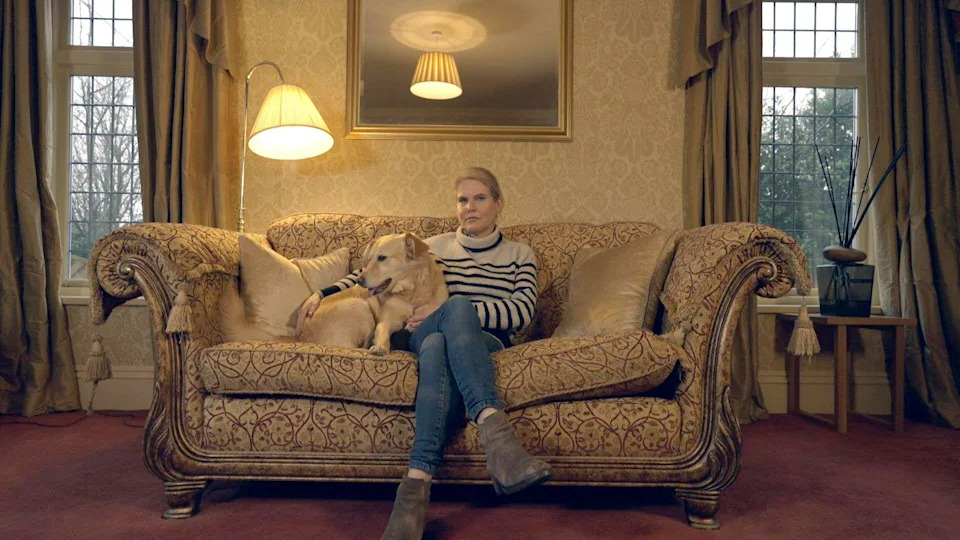
Nicola Baird says her canine Sebi has impressed her activism in opposition to sham animal shelters in Uganda [BBC]
What Lubajja most likely didn’t know is that the account is run by a 49-year-old lady who lives some 10,000km away in Yorkshire, within the north of England.
Nicola Baird, the founding father of We Will not Be Scammed, is on the warpath.
“The scammers, I simply have hatred for them,” she tells the BBC. “They’re the epitome of evil.”
As with others in her community of 20 activists, Baird was as soon as a sufferer. She despatched cash to a person in Mityana who mentioned his canine wanted surgical procedure after a visitors accident.
When she acquired pictures and movies of the canine’s alleged surgical procedure, Baird began to suspect one thing was mistaken. Veterinary docs she shared the pictures with confirmed that they regarded extra like abuse than veterinary care. “That is once I thought: ‘Oh my goodness, I’ve enabled this abuse.’
“And that is when it turned an actual ardour to cease the abuse as a result of I felt like they have been abusing [my dog] Sebi – they’re abusing a part of my household.”
This expertise formed Baird’s perception that animal accidents proven in social media movies – together with burns, cuts and even lacking limbs – have been intentionally inflicted, a view shared by different on-line activist teams monitoring accounts linked to Mityana.
Lubajja confirms to the undercover group that there have been cases the place scammers have injured canine on objective.
“Once they ran out of content material, some individuals began slicing the canine and requested for cash,” he says.
However he provides the escalation backfired when some donors began seeing via the abuse and warning others.
“[Scammers] now not reduce the canine [because] they misplaced cash when the white individuals realised.”
Baird acknowledges that scammers’ ways have modified because of elevated scrutiny, however maintains canine are nonetheless being intentionally harm and stay at risk.
“All that ache is only for just a few donations,” she says. “No animal ought to must dwell like this.”
We Will not Be Scammed and different on-line activists suppose that Russet, the canine who was filmed in conjunction with the highway and featured in dozens of fundraising movies, had his legs intentionally damaged.
Through the undercover filming, Lubajja is proven a video of Russet and he identifies it as one among his canine. When pressed for extra particulars by the journalists, he says the canine had been concerned in a visitors accident simply exterior the shelter.
However that will not have been the case.
After his preliminary social media look, Russet’s picture was posted on a number of totally different accounts, seemingly as he was handed from one scammer group to a different.
Round three weeks later, a British social media person and donor, who needs to stay nameless, managed to barter Russet’s launch from the scammers to a veterinary clinic in Kampala.
Dr Isa Lutebemberwa went to Mityana to select the canine up and took him to his clinic for remedy, which was funded by the UK donor.
Russet’s remedy included an operation to restore his damaged legs [BBC]
In Lutebemberwa’s opinion, the possibilities that Russet’s accidents resulted from an accident have been low. Describing an X-ray of Russet’s decrease physique, he says: “For those who have a look at these bones, all of them have been damaged nearly in the identical place.
“In case you are concerned about breaking a bone, it is the place you’d go for, as a result of it’s the weakest.”
Lutebemberwa operated on Russet. He survived the surgical procedure however died a few days later.
“For those who regarded in his face, you’d see that he had endured numerous struggling,” Lutebemberwa tells the BBC. “Given all the pieces he had gone via, he didn’t should die.”
“Russet confirmed me the ache a canine which is on the market can undergo.”
The BBC contacted Lubajja, who had informed the undercover journalists he had been the proprietor of Russet, for touch upon the findings of the investigation.
When despatched pictures of Russet with the allegations, he mentioned he didn’t recognise the canine and denied injuring animals. He acknowledged that content material creators pay to movie at his shelter.
For those who’re exterior the UK, you may watch the documentary on YouTube or hearken to the podcast right here.
Lutebemberwa and different animal activists in Uganda like Kakooza partially blame worldwide donors for the struggling of canine in Mityana’s shelters, saying they usually donate impulsively and with out sufficient scrutiny.
“People who find themselves donating cash are inflicting the issue of animal cruelty right here, as a result of they carry on fuelling it, they’re fanning the fireplace,” says Kakooza.
Baird agrees that donations might inadvertently have prompted hurt: “I believe the message that now we have to take from Russet’s abuse is the donations extended his agony. Had individuals not donated, Russet wouldn’t have suffered so long as he did.”
Most animal activists, in Uganda and past, suppose that extra consciousness amongst social media customers and potential donors would scale back the movement of donations to Mityana’s shelters. This might dampen scammers’ revenue and the attraction of the enterprise amongst younger individuals, and result in fewer new canine being captured for the scams.
Nonetheless, few can level to a concrete resolution for the canine who’re at present within the shelters.
Mityana police informed the BBC that an operation in 2023 rescued 24 severely injured canine stored in poor circumstances at a sham shelter on the town, and transferred them to Kampala for remedy.
Three suspects arrested within the operation have been charged with cruelty in opposition to animals earlier than being launched. Their file was later closed, and so they got a warning.
Now, a world coalition of activists, together with Kakooza, is attempting to make use of non-public prosecutions to deal with the issue. One is already within the works.
“We hope this case can be a deterrent for a lot of different individuals who want to proceed working on this unlawful commerce,” he tells the BBC.
Extra from BBC Africa Eye:
[Getty Images/BBC]
Go to BBCAfrica.com for extra information from the African continent.
Observe us on Twitter @BBCAfrica, on Fb at BBC Africa or on Instagram at bbcafrica