


Sub-Saharan Africa may break up up in a couple of million years, and scientists imagine they may be witnessing the early levels of this geological course of.
The break up would happen alongside the Kafue Rift, which is a part of a roughly 1,500-mile-long (2,500-kilometer) rift line spanning from Tanzania to Namibia. A rift is a crack in Earth’s crust that disturbs the floor and might trigger sinking land and earthquakes. 1000’s of rifts exist world wide, and whereas the bulk are inactive or useless, they’ll often reactivate.
Geologists thought the Kafue Rift was lengthy useless. However some specialists now say it has proven indicators of exercise previously few a long time. Rising proof is elevating suspicion that the function could possibly be turning into a brand new continental rift — and will finally grow to be a brand new boundary between tectonic plates, making a brand-new sea within the course of.
Earlier research have collected these clues. Earthquakes too faint to be felt by individuals however robust sufficient to be picked up by devices, elevated underground temperature, and minute adjustments within the elevation of the bottom noticed with satellites all recommend that the world could also be tectonically lively.
Now, a brand new research printed Monday within the journal Frontiers in Earth Science goes one step additional. “We’ve got the primary geochemical knowledge from this space,” mentioned Rūta Karolytė, who led the research when she was a postdoctoral analysis fellow on the College of Oxford in England. “That’s fairly a distinct line of proof that basically strengthens the concept that we now have rift exercise within the space.”
Learning a brand new continental rift would assist reply one of the crucial basic questions in tectonics.
“How does a brand new plate boundary start? Mature plate boundaries are simple to acknowledge. The earliest levels are way more refined,” mentioned Estella Atekwana, a distinguished professor of Earth and planetary sciences on the College of California, Davis, who didn’t participate within the research.
“If the Kafue Rift is a part of a new child plate boundary, it offers us a uncommon alternative to check the beginning of a plate boundary earlier than volcanism, massive earthquakes, and main floor deformation have overprinted the unique situations.”
Clues to a brand new tectonic plate
To assemble the proof, Karolytė and her colleagues collected samples from sizzling springs and geothermal wells in Zambia which have naturally appeared above the suspected rift. “There’s sizzling water effervescent as much as the floor, and we sampled the fuel that’s developing from that,” mentioned Karolytė, who’s presently a principal product scientist at UK-based Snowfox Discovery, a pure hydrogen exploration firm.
The researchers had been wanting primarily on the ratio between two varieties of helium — helium-3 and helium-4. The staff hunted for a telltale signal that the springs and wells had a reference to Earth’s mantle, the layer sandwiched between the crust and the core that’s lots of of miles thick. “We discovered extra helium-3 than you’d usually discover within the crust, which is usually a sign of mantle fluids developing into the water,” Karolytė added.
The researchers collected fuel samples for the research from a sizzling spring in Zambia’s Gwisho space. – P. Vivien-Neal/Kalahari Geo-Vitality & M. C. Daly/College of Oxford, UK
The result’s solely preliminary as a result of the samples come from simply six websites in a extremely concentrated space. However the researchers additionally sampled two sizzling springs about 60 miles (95 kilometers) from the suspected rift and didn’t discover a related enhance within the helium-3 ratio.
Since materials from the mantle can attain the floor as tectonic plates stretch and start to separate aside, the research staff believes this new geochemical knowledge might function an early sign hinting on the formation of a brand new plate boundary.
An financial profit
Tectonic plates are gigantic slabs of stable rock ranging in measurement from a couple of hundred to 1000’s of miles throughout, with a thickness of as much as about 120 miles (190 kilometers). Ever since these plates developed early in Earth’s historical past, they’ve been sliding over the mantle at a velocity corresponding to the expansion fee of fingernails. About 200 million years in the past, the shifting plates began to separate an enormous landmass known as Pangea into in the present day’s continents. The plates are nonetheless shifting, and that motion drives geological processes corresponding to earthquakes and the formation of volcanoes.
The boundaries between plates are principally below the oceans, they usually can slide previous one another, crush collectively or drift aside. The boundaries are additionally the areas the place a lot of the earthquakes and volcanic exercise occur.
An lively, creating rift can flip right into a tectonic plate boundary — however not essentially. “These rifts typically begin and cease, or they’ll unfold just a little bit and cease once more. It’s onerous to foretell what is going to occur,” Karolytė mentioned.
Africa already has a well-developed rift that’s tens of hundreds of thousands of years previous. The East African Rift has a number of volcanoes and is seismically lively. Nevertheless, it could take a very long time for the brand new rift to develop in such a method after which flip right into a plate boundary. “On the quickest, it may occur in a few million years. On the slowest, it may take 10 or 20 million years,” mentioned research coauthor Mike Daly, a visiting professor in Earth sciences on the College of Oxford.
“The southern a part of Africa would break off, however earlier than that, you’ll begin to see much more earthquakes, and a few volcanic exercise with lava flowing out. You’d begin to have deep rifts, and water would begin to stagnate in it, so that you’d get lakes as you get in East Africa in the present day, and finally you’d get the ocean,” he added.
Within the a lot nearer time period, nevertheless, Zambia may economically profit by harnessing power — geothermal crops are rising within the space. The landlocked nation may probably even accumulate the helium, which is in excessive demand and has a number of purposes in drugs and the tech business.

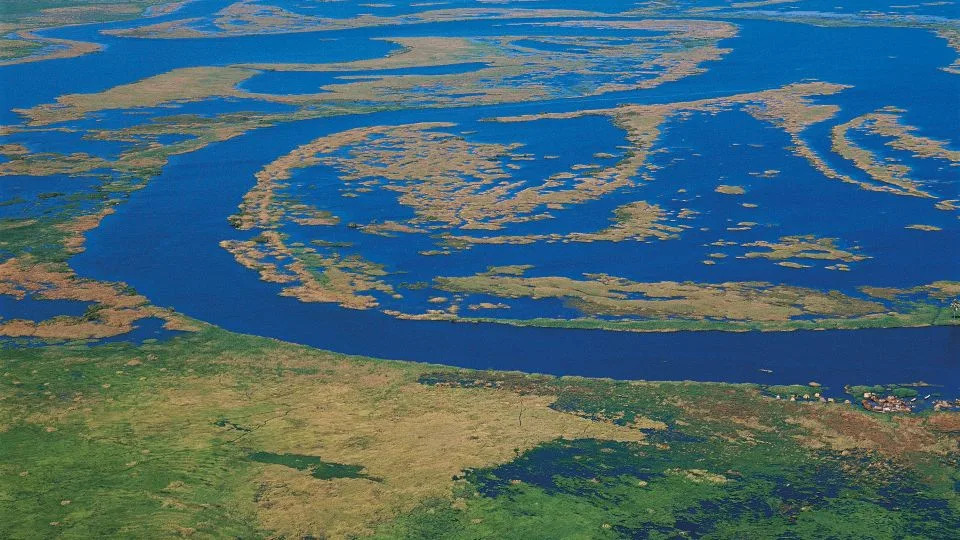
An aerial view captures the Kafue River marshes in Zambia. – DeAgostini/Getty Photos
To substantiate the findings, the researchers are accumulating extra fuel from a wider geographical space alongside the suspected rift, and they’re already engaged on a brand new research with broadened outcomes.
Answering basic questions
Folarin Kolawole, an assistant professor within the division of Earth and environmental sciences of Columbia College in New York who wasn’t concerned with the research, thinks the findings are novel and thrilling as a result of they supply a “robust affirmation” that there’s direct upward movement of fluids from the mantle to the floor by way of newly forming rift zones.
“The important thing significance of a brand new plate boundary in southwestern Africa is that we now have a longtime pathway for the continent to interrupt up from jap Africa throughout Botswana and Namibia to the Atlantic Ocean,” he added in an e-mail.
The variety of samples is proscribed, however the outcomes are nonetheless important, in response to UC Davis’ Atekwana. “They supply robust geochemical proof that the Kafue Rift is lively at depth, although magma has not reached the floor,” she wrote in an e-mail.
Atekwana added, nevertheless, that extra proof alongside the entire proposed boundary is required to find out whether or not the mantle’s helium sign is steady or solely native. “That is one vital line of proof, not the ultimate phrase. It helps the speculation of early-stage rifting, however confirming a brand new plate boundary requires a full plate-boundary-scale check,” she mentioned.
“This doesn’t imply Africa is splitting aside tomorrow; these processes unfold over hundreds of thousands of years. However scientifically, it could be like catching a plate boundary within the act of being born.”
Join CNN’s Marvel Principle science publication. Discover the universe with information on fascinating discoveries, scientific developments and extra.
For extra CNN information and newsletters create an account at CNN.com