






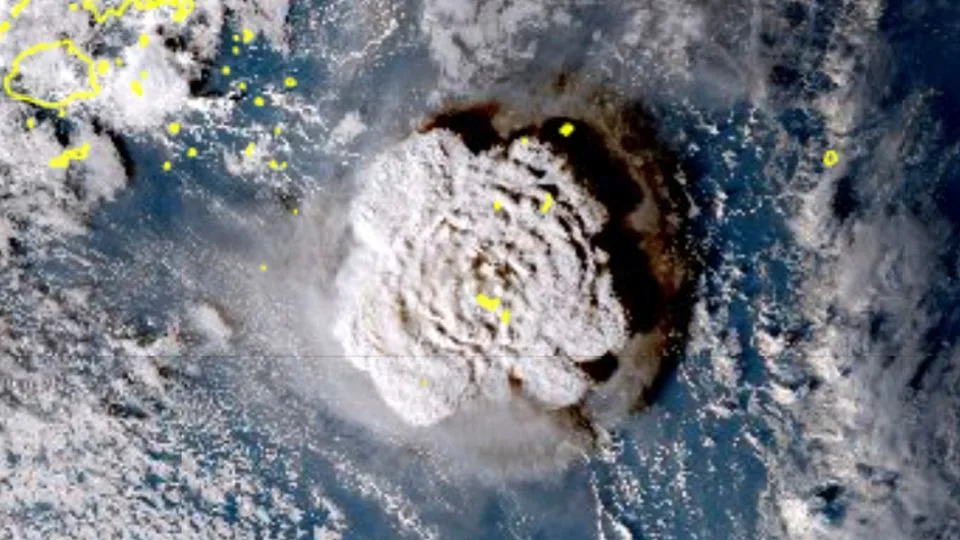
When an underwater volcano erupted within the South Pacific in January 2022, it despatched a plume of ash, steam and gasoline practically 40 miles above the Earth’s floor. It was one of the crucial violent volcanic eruptions of contemporary occasions. It might even have additionally revealed a brand new weapon within the combat towards a potent planet-heating gasoline, in response to new analysis.
The Hunga Tonga-Hunga Ha’apai volcano erupted with an influence lots of of occasions stronger than the Hiroshima nuclear explosion, setting off a tsunami and a sonic growth that went across the planet twice. It then did one thing “sudden,” in response to the authors of the brand new research revealed Thursday within the journal Nature Communications. It began cleansing up a few of its personal air pollution.
The scientists’ discovery got here from taking a look at superior satellite tv for pc information of the eruption. “We discovered an enormous cloud of formaldehyde that ought to usually not be there,” mentioned Maarten van Herpen, a research writer, and a physicist and government director at Acacia Impression Innovation, a Dutch consultancy. Formaldehyde typically types when methane, a potent planet-heating gasoline, is destroyed within the ambiance.
The researchers believed they had been observing a chemical course of that had beforehand been recognized over the Atlantic Ocean.
Scientists had discovered that when Saharan mud is blown over the Atlantic, it mixes with salt spray and types small iron-based particles. As the daylight hits them, it produces chlorine atoms, which react with methane within the ambiance and assist break it down.
One thing comparable seems to have occurred with the Hunga Tonga-Hunga Ha’apai volcano, in response to the research. Its eruption despatched sufficient salty water vapor into the stratosphere to fill round 58,000 Olympic-size swimming swimming pools together with volcanic ash. The research scientists imagine that when the daylight hit the combination, chlorine shaped and broke down among the methane produced by the eruption.
“It has emitted methane after which destroyed these emissions by way of the particles within the plume,” van Herpen mentioned.
A satellite tv for pc picture of the eruption, which despatched a plume of ash, steam and gasoline practically 40 miles into the stratosphere. – Japan Meteorology Company through AP
They tracked the formaldehyde cloud for 10 days. “As a result of formaldehyde solely exists for a couple of hours, this confirmed that the cloud should have been destroying methane repeatedly for greater than per week,” van Herpen added.
The researchers estimate the eruption produced round 330,000 tons of methane, of which round 900 tons had been damaged down a day.
It’s “new — and utterly stunning” that the identical course of noticed within the Atlantic seems to have performed out in a volcanic plume excessive up within the stratosphere, mentioned Matthew Johnson a research writer and chemistry professor on the College of Copenhagen, who was concerned within the 2023 discovery.
The scientists say their findings may present a priceless new device to sort out local weather change.
Methane is round 80 occasions simpler at trapping warmth than carbon dioxide over a 20-year interval. It presently accounts for round a 3rd of worldwide warming and concentrations within the ambiance have doubled during the last two centuries.
Though decreasing carbon air pollution, which stays within the ambiance for lots of of years, is essential to tackling the local weather disaster, slashing methane has been seen as one thing of a low-hanging fruit. It’s comparatively short-lived, and reducing ranges may have an essential affect on decreasing international heating within the short-term.
Pete Edwards, an atmospheric chemist on the College of York who was not concerned within the analysis, mentioned the findings had been attention-grabbing however “very troublesome” to substantiate. “The usage of solely formaldehyde observations to deduce a mechanism, though novel, doesn’t assist handle the identified uncertainties inside our present understanding of atmospheric chemistry,” he advised CNN.
The findings may theroetically be used to destroy methane emissions on the supply, van Herpen mentioned. They may additionally inform geoengineering strategies — makes an attempt to artificially convey down international temperatures. Iron-based particles might be injected into the ambiance over the ocean to imitate the chemical course of noticed within the wake of the eruption and take away methane.
However Edwards urges warning. The research relies on the stratosphere, whereas this methane elimination technique would occur within the troposphere, he mentioned. The impacts could be troublesome to foretell, he added, “with potential unintended penalties on local weather, air air pollution and ecosystem well being.”
Emily Dowd, a local weather scientist on the College of Leeds, echoed this. “The proposed chemistry nonetheless must be totally examined in atmospheric fashions,” she advised CNN.
The research authors agree extra analysis must be carried out. “It’s an apparent concept for business to attempt to replicate this pure phenomenon — however provided that it may be confirmed to be protected and efficient,” Johnson mentioned. “Our satellite tv for pc technique may provide a manner to assist determine how people would possibly gradual international warming,”
For extra CNN information and newsletters create an account at CNN.com