

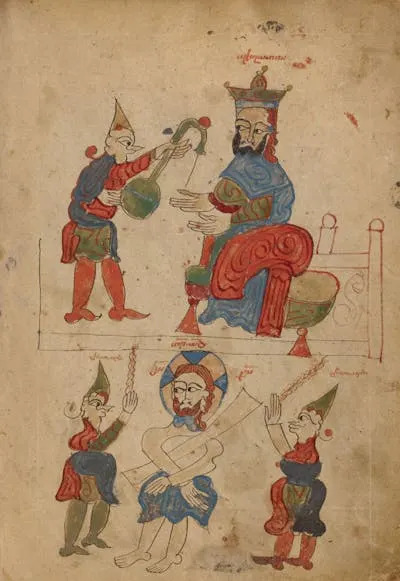

It’s a simple a part of the Easter story: The Roman governor Pontius Pilate had Jesus of Nazareth killed by his troopers. He imposed a sentence that Roman judges usually inflicted on social subversives – crucifixion.
The New Testomony Gospels say so. The Nicene Creed, one among Christianity’s key statements of religion, says Jesus “was crucified underneath Pontius Pilate.” The testimony of Paul, the primary particular person whose preaching within the title of Jesus Christ is preserved within the New Testomony, refers back to the crucifixion.
However over the previous 2,000 years, it was frequent for some Christians to deem Pilate nearly innocent for Jesus’ loss of life and deal with Jews as accountable – a perception that has formed the worldwide historical past of antisemitism.
All through medieval instances, Easter was usually a harmful time for Jewish communities, whom Christians focused as “Christ-killers.” This notion was integral to the hate that motivated mass violence in Europe as late because the nineteenth and twentieth centuries, together with pogroms in Russia and even Nazi genocide.
Why did Christian teachings virtually let Pilate off the hook? Why did many Christians allege Jews had been guilty?
The Gospels’ story
Within the Gospels, the primary 4 books of the New Testomony, Pilate believes Jesus harmless of any crime. In a few of them, he even proclaims so in public.
However the chief monks of the traditional Jewish temple at Jerusalem see Jesus as a charismatic and widespread Jewish preacher who challenges their authority. They’ve Jesus arrested and tried earlier than Pilate in the course of the week of Passover.
Pilate schemes for Jesus’ launch, however a riotous crowd clamors for his loss of life. Pilate caves and decides to crucify Jesus, whom Christians consider rose from the lifeless three days later.
Any reader of the Gospels is aware of the sequence, although it varies considerably in every of them. The earliest Gospels, composed not less than a era after Jesus’ loss of life, blamed the chief monks and attending crowd for persuading Pilate to have Jesus crucified. The Gospel of John, written some many years after the opposite three, portrayed Jews on the whole as accountable, and so did a lot of early Christian literature.
One account, written within the mid-second century or later, and never included within the New Testomony, even claimed that Jesus’ crucifixion was not ordered by Pilate. As an alternative, it blamed Herod Antipas, the Jewish ruler of Galilee – the area the place Jesus grew up. Different texts from after the primary few centuries A.D. stated that Pilate turned a Christian.
Roman historical past
Students have lengthy debated the historic details of Jesus’ trial. In my 2025 guide, “Killing the Messiah,” I do too.
The Gospel testimonies seize the fundamentals of felony trials earlier than Roman judges, which had been held in public. Judges posed inquiries to prosecutors and defendants, and had ample energy to determine whether or not an individual was harmless or responsible and impose a punishment.
Writers who lived within the Roman Empire portrayed judges as capricious, unaccountable or swayed by menacing crowds. The Gospels mirror this perspective by making Pilate seem bullied into condemning an harmless man.

However from a historian’s viewpoint, there’s a essential downside with the Gospels’ description. Roman judges may and generally did face elimination from workplace, property confiscation, exile and even loss of life for executing clearly harmless folks. In different phrases, it appears unlikely that Pilate would have proclaimed Jesus guiltless, however then conceded to strain and condemned him anyway.
Different historic writers describe Pilate as somebody who was not above offending the Jews of Judaea. In keeping with the first-century Jewish thinker Philo and the historian Josephus, Pilate had his troopers carry objects that honored Roman emperors into Jerusalem, which Jewish residents noticed as sacrilegious. When crowds protested, he generally backed down. However his troopers attacked an agitated crowd that opposed Pilate’s use of Temple cash to construct an aqueduct. In addition they massacred an revolt of Samaritans – individuals who additionally claimed descent from Israelites.
Pilate didn’t cave to hostile crowds indiscriminately, or do regardless of the chief monks wished. Since Roman prefects like him needed to coordinate with Jewish monks to control Jerusalem, he doubtless considered individuals who incited social disturbance in opposition to them as subversive. Jesus would have slot in that class, however neither Philo nor Josephus offers examples of Pilate killing folks after acquitting them.
Rising divide
Why, then, did Pilate have Jesus crucified? As many students have argued, the straightforward reply can be that he believed Jesus dedicated some type of sedition – not that the group merely pressured Pilate into doing so.
But, when the Gospels had been composed a era after the crucifixion, they portrayed Pilate as satisfied of Jesus’ innocence. As extra time handed, different works of historic Christian literature shifted accountability from Pilate to Jews.
The experiences of Jesus’ early followers assist clarify this shift. They, like Jesus himself, had been Jewish, and so they thought-about him a heaven-sent Messiah. However over the course of the primary and second centuries, they more and more separated themselves from different Jews, till they started to see themselves as members of a non-Jewish motion: Christianity.
In Roman authorities’ eyes, the Christians had been troublesome, and so they generally confronted prosecution and capital punishment. As well as, Rome had inflicted atrocities and punitive measures upon Jews after insurgencies – additional motivating Jesus’ followers to distance themselves. Their literature turned more and more hostile towards Jews.
Historians and biblical students proceed to debate why Pilate condemned Jesus. Was it for suggesting that he was the Messiah, or, in Pilate’s wording, “King of the Jews”? Did Jesus incite a crowd disturbance on the Temple throughout Passover – or had been officers anxious he may, even inadvertently? Had been Jesus and his followers engaged in armed revolt?
However whatever the reply, as I argue in my guide, accountability for the crucifixion lies with Pilate – not the chief monks and the Jewish crowd at Jerusalem.
This text is republished from The Dialog, a nonprofit, unbiased information group bringing you details and reliable evaluation that will help you make sense of our complicated world. It was written by: Nathanael Andrade, Binghamton College, State College of New York
Learn extra:
Nathanael Andrade has acquired fellowship funding from the Andrew Mellon Basis/the Institute for Superior Research at Princeton, the Institute for Analysis within the Humanities on the College of Wisconsin, and the Alexander von Humboldt Basis.