


New York Metropolis Mayor Zohran Mamdani introduced this week that the Huge Apple’s first city-owned grocery retailer will open within the South Bronx someday subsequent 12 months, delivering on a central promise of his dark-horse 2025 marketing campaign — and pitching the challenge, which goals to place one public, nonprofit grocery store in every borough by the tip of his first time period, as “bodily proof of our conviction that authorities generally is a power for good.”
“We’re going to use the ability of presidency to decrease costs and make it simpler for New Yorkers to place meals on the desk,” Mamdani, a 34-year-old Democrat and democratic socialist, mentioned on Monday. “When authorities understands its goal as serving the very working those who it has left behind, repeatedly, it could actually make a distinction in essentially the most urgent struggles going through our metropolis in the present day.”
At a time of rising meals costs, ought to different governments throughout the U.S. take into account following in Mamdani’s footsteps? Or are publicly owned grocery shops incompatible with American capitalism?
Sticker shock on the grocery store is nothing new; it was considered one of voters’ greatest gripes in the course of the 2024 presidential marketing campaign and the pandemic interval that preceded it. But, the newest spikes — pushed largely by power prices tied to the Iran conflict and President Trump’s tariffs — have been particularly pronounced.
Authorities knowledge launched final week confirmed that U.S. grocery costs shot up quicker in April than in any month in practically 4 years. Right now, seafood prices 6.2% greater than it did a 12 months in the past. Recent greens price 11.5% extra. Beef prices 14.8% extra. Espresso prices 18.5% extra. Tomatoes price 39% extra. And people hikes are on high of pandemic-era inflation that had already pushed up meals costs by roughly 25%.
Right here’s how Mamdani’s city-owned grocery shops will work — and a few execs and cons on whether or not the thought might ever be possible past New York.
Mamdani’s plan
In concept, the mayor’s plan is fairly easy: use municipal assets to decrease overhead and working prices for grocery shops, then go these financial savings on to shoppers within the type of decrease costs.
In observe, right here’s what which means — not less than to this point.
One 20,000-square-foot grocery retailer is scheduled to open in 2027 on the Peninsula, a brand new live-work campus within the Hunts Level neighborhood of the South Bronx, developed partly by the town’s Financial Growth Company and constructed on the location of a former juvenile detention facility.
A second retailer will open in 2029 at La Marqueta, a city-owned market underneath elevated prepare tracks within the predominantly Latino neighborhood of East Harlem in Manhattan.
Areas within the different three boroughs — Brooklyn, Queens and Staten Island — are at the moment being vetted.
The purpose with all 5 grocery shops, in keeping with Mamdani’s workplace, is to “prioritiz[e] Metropolis-owned websites wherever potential.” Why? So his administration can waive hire and actual property taxes, slashing a serious expense.
Town would additionally pay to construct and outfit the shops. To that finish, Mamdani has to this point requested $70 million in capital {dollars} — a request the Metropolis Council nonetheless must approve. (The East Harlem outpost would price roughly $30 million to stand up and working, in keeping with the mayor’s workplace.) Mamdani has mentioned that the cash for his public grocery shops might come, not less than partly, from scaling again an current program that provides tax breaks and particular regulatory aid for personal supermarkets that open in underserved areas (a.okay.a. “meals deserts”).
Past constructing the shops and letting them function rent- and tax-free, the entire city-owned moniker turns into a bit deceptive. The Mamdani administration doesn’t plan to run these new shops. As an alternative, that job would go to non-public “third-party grocery operator(s)” who can be chosen “by means of a aggressive procurement course of” — then monitored to make sure they’re conserving costs as little as potential.
Prior to now, Mamdani has likened the thought to a “public possibility” for groceries reasonably than state-run — or on this case, city-run — supermarkets.
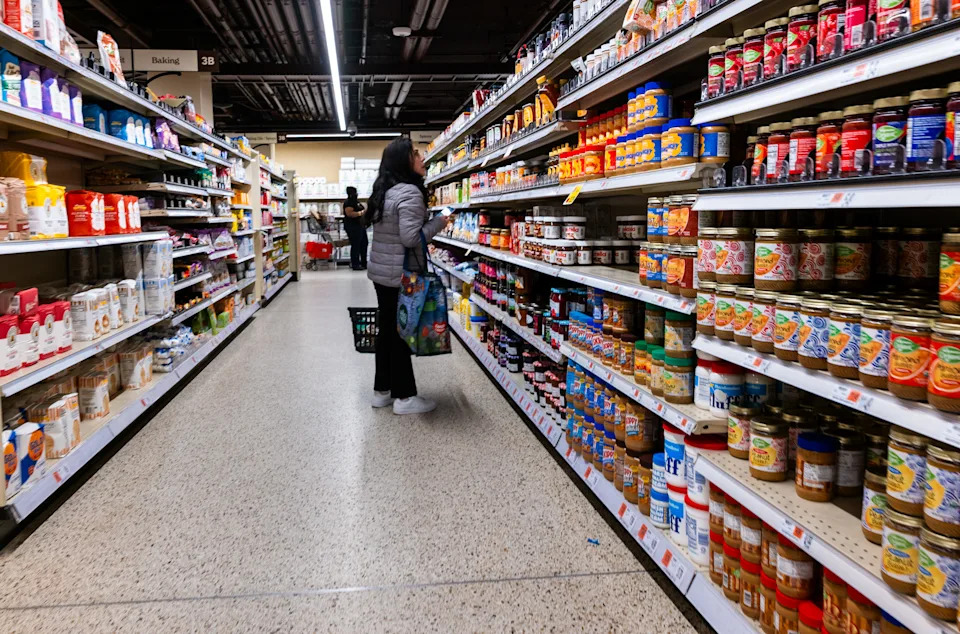
Individuals store at a grocery retailer in Manhattan.
(Spencer Platt/Getty Photographs)
Is that this occurring wherever else?
Really, it’s. Just a few, scattered rural municipalities have tried opening their very own grocery shops to fill the void after different native choices closed. The city of Baldwin, Fla. — inhabitants: about 1,300 — bought its shuttered market in 2019 and operated it like a public utility for about 5 years. The same city-owned retailer has been thriving for greater than a decade in St. Paul, Kan., a city of 600 residents.
Huge cities past New York have began to discover the thought as effectively.
Chicago Mayor Brandon Johnson, one other progressive Democrat, commissioned a 105-page feasibility research that discovered city-owned grocery shops have been “mandatory, possible and implementable” — however his administration finally determined to focus on city-owned markets with a number of impartial distributors as an alternative.
In Madison, Wis., development started in February on a municipally backed grocery retailer situated on the primary flooring of a mixed-use reasonably priced housing constructing owned by the town. It’s anticipated to open by the tip of the 12 months.
In Atlanta, Democratic Mayor Andre Dickens partnered with chain Savi Provisions to open the town’s first municipally sponsored market in September, contributing $3.5 million of the challenge’s $5.4 million price.
And in Washington, D.C., two mayoral candidates — each Democrats — simply debated the thought final month.
Will it work?
That’s the query Mamdani’s new “community” of 5 city-owned grocery shops is designed to check. It’s successfully the most important public-grocery pilot program in U.S. historical past.
For his half, the mayor has lengthy insisted that his shops will have the ability to “purchase and promote at wholesale costs,” partly by “centraliz[ing] warehousing and distribution.” His pondering is that the extra the town scales up — the extra shops it opens — the simpler that course of will get.
A Yahoo/YouGov ballot carried out final 12 months discovered that 51% of People accepted and 31% disapproved of making “a community of government-owned grocery shops centered on conserving costs low reasonably than making a revenue” — a +20-point margin.
However critics have doubts.
Probably the most vociferous objections come from conservatives and Republicans, who are inclined to dismiss the idea of a city-owned grocery retailer as “FULL DERANGED MARXIST” whereas conjuring bleak photos of Soviet-era breadlines. “Probably the most terrifying phrases within the English language are, ‘I’m Zohran Mamdani, & I’m right here to run your grocery retailer,’” GOP Rep. Younger Kim of California wrote Tuesday on social media.
Some economists and small-business homeowners have additionally weighed in towards Mamdani’s plan — which, once more, calls for personal contractors to really run the shops. They argue that city-owned grocery shops might undercut mom-and-pop companies, forcing many to shutter. Additionally they declare the strategy is economically inefficient. Revenue margins within the grocery enterprise already are notoriously low, they are saying — simply 1% to three% — and the entire system is dependent upon an intricate infrastructure of cooperative distributors, quantity reductions and branded promotions which may be troublesome to duplicate in a public, nonprofit community.
For now, Mamdani’s response is to say, basically, that city-owned grocery shops are price a attempt.
“It’s not simply that authorities may help,” the mayor mentioned on Monday. “It’s that authorities should assist. And our authorities will assist.”