


In any dialogue of drone protection, Gatling-type weapons are sometimes introduced as a trump card. These rapid-fire weapons, initially developed to defend U.S. warships towards sea-skimming missiles, can simply down greater and sooner threats than a 120 mph Shahed drone. On paper they appear devastatingly efficient, and information experiences communicate enthusiastically of their “shredding Iranian drones.” However they don’t seem to be a magic wand to make all drones disappear, and a few Shaheds are getting by way of.
A better take a look at movies of those weapons in motion, and at their precise capabilities, offers a fuller image of what’s actually occurring – and the essential function of ammunition provide.
The Final Line Of Protection
The Centurion C-RAM (“Counter Rocket, Artillery and Mortar”) was first deployed in Iraq in 2006 and is a land-based variant of the unique Phalanx CIWS (“Shut In Weapon System”) utilized by the Navy since 1980. It’s the final line of defence when pressing motion is required to stop casualties. The land model is a self-contained unit weighing round 24 tons and costing one thing over $4 million.
Counter Rocket, Artillery and Mortar (C-RAM) system situated at an undisclosed location within the U.S. Central Command space of operations, Aug. 3, 2025
U.S. Military photograph by Pvt. Jordan Foster
Because the title suggests, C-RAM was launched to guard bases towards rocket, artillery and mortar fireplace. It has an built-in radar which tracks incoming projectiles in addition to the stream of rounds fired by the 20mm M61A1 Gatling gun to place them on the right track.
The cannon is similar as that carried by F-15 and F-16 fighters. Its distinguishing function is its phenomenal fee of fireplace, the six electrically-powered spinning barrels selectively firing 3,000 to 4,500 rounds per minute – that’s 50 to 75 per second — producing a sound like a buzzsaw, usually rendered as “Brrrrt.”
Whereas the Navy model fires strong tungsten projectiles, CRAM makes use of the M940 Multi-Objective Tracer – Self-Destruct spherical. This weighs 3.5-ounces/99 gram and consists of a tungsten cone to punch by way of the goal pores and skin, and a physique which explodes in a dense mass of fragments contained in the goal. “Tracer” means the spherical produce a visual glow, and in operation the stream of projectiles seems as a shiny ribbon reaching out in direction of the goal. Automated monitoring shifts intention till that ribbon overlaps the goal.

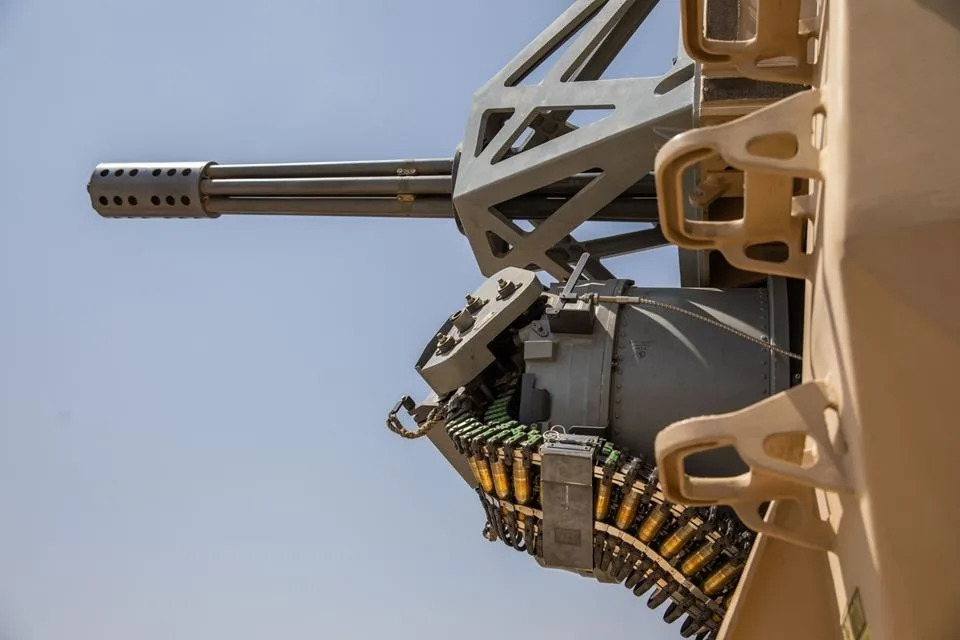
C-RAM at at Erbil Air Base, Iraq, July 9, 2025 displaying ammunition feed.
U.S. Military photograph by Sgt. Steve Asfall
The “Self-Destruct” half implies that the rounds mechanically explode at a spread of round 2,300 meters in the event that they miss the goal, an impact additionally extremely seen on movies of CRAM engagements. CRAM is a degree protection system positioned to guard high-value property. If a drone strikes simply couple of miles away the operators can solely watch.
CRAM has {a magazine} of 1,500 rounds. This appears like so much, supplying 30 one-second bursts of fifty rounds every. However it is just sufficient for 10 two-second bursts on the greater fee of fireplace. It reportedly takes some half-hour to reload CRAM manually with 15 containers of ammunition every weighing round 60 kilos.
Every M940 spherical prices $168, so a 150-round burst prices round $25k, akin to the value of a Shahed.
Centurion In Motion
Due to the way in which that CRAM lights up the evening sky and the way a lot noise it makes, it’s onerous to maintain its operation secret. Within the final month many engagements have been filmed and shared on social media. A few of these are clearly profitable.
This video, from the week March Sixteenth-Twenty second, reveals CRAM taking pictures down a Shahed near the U.S. Embassy in Baghdad. The drone is visibly hit thrice by the stream of rounds in a 2-second burst and falls from the sky.
A second video additionally from the defence of the Baghdad Embassy and dates March Twenty second reveals a CRAM firing three bursts – roughly 1 second, 1 second and three second length – downing an incoming Shahed with the third.
In different circumstances it’s onerous to inform if the CRAM is discovering a goal. This video, labeled “CRAM partaking incoming Iranian drones over Erbil, Iraq, earlier tonight” from March twenty eighth reveals a 7-second burst of fireplace with no apparent hits. One other, shot in Syria and posted on March twenty ninth, is a 4-second burst with no consequence. One other displaying the U.S. Embassy in Baghdad on March seventeenth is of a 6-second burst snaking throughout the sky with no hits.
In some circumstances the CRAM evidently misses. This March twenty first video reportedly reveals an assault on a U.S. base in Baghdad, with a 1-second burst adopted by an explosion close to the firing the situation of the CRAM.
CRAM’s Drone Downside
This selective view tells little in regards to the precise fee of hits and misses. A success on a drone will not be seen within the evening sky, as they don’t essentially explode when hit. Equally there could have been many extra unsuccessful engagements not filmed.
What we do know is that the reported success fee towards rockets and mortar shells in Iraq was reportedly 70-80% with a mean of 300 rounds per engagement. These are comparatively handy targets as a result of, though they’re shifting quick, they arrive in on a really predictable trajectory they usually descend from excessive within the sky making them simple to pick on radar.
Tackling drones could also be harder. Being product of composite materials fairly than metallic, they could have a small radar reflection. And Shaheds can fly at extraordinarily low stage, typically at below 100 toes with a flight path that takes them between buildings. The extent of background litter will make radar monitoring difficult.
As well as, on the Baghdad Embassy the Giraffe 1X radar controlling CRAM was broken by a drone hit, doubtlessly rendering it ineffective. This implies the Iranians knew they needed to destroy this primary, leaving different targets open to assault.
In contrast to rockets and artillery, Shaheds don’t must fly on a predictable path. A number of the Russian variations mechanically perform evasive maneuvers after they sense a risk. Because the movies present the stream of rounds could be seen and doubtlessly evaded. This dodging would at least enhance the variety of rounds wanted for a kill. Russian Shaheds are additionally accompanied by numbers of low-cost Gerbera decoys to distract and deplete defenses. Iran doesn’t but appear to have both functionality.
The variety of rounds in {a magazine} could also be a giant problem. CRAM was not referred to as on usually in Iraq. A number of methods have been deployed throughout no less than 5 websites in Iraq, however over 16 years of deployments it was reportedly used lower than 400 instances. This implies every system on common solely fired as soon as each few months nd ammunition was not then an element.
Judging from what we have now seen, CRAM could take a number of seconds to efficiently interact a drone, so they could solely be capable to shoot down 4 or 5 earlier than operating out of ammunition. On condition that Iran is attacking with waves of Shaheds, one CRAM will not be sufficient.
There’s additionally the problem of ammunition stockpiles. The U.S. Military solely acquired about 20,000 rounds of M940 this yr, which one weapon may burn by way of in 5 minutes of firing. Extra provides are doubtless being procured urgently behind the scenes.
Some Shaheds are getting by way of, with a number of hits seen within the space across the Embassy in Baghdad. Whereas CRAM appears to be like nice and is extremely efficient in its supposed function, it’s merely not designed to deal with massive numbers of Shaheds.
Sting, a low-cost, long-range different to the 24-ton CRAM.
Ukraine MoD
For that process, the form of small interceptor drones developed by Ukraine, costing a number of thousand {dollars} every and built-in with radar and different sensors could also be a much better wager. That is very true for a long-term battle when the Shaheds could hold coming evening after evening.
This text was initially printed on Forbes.com